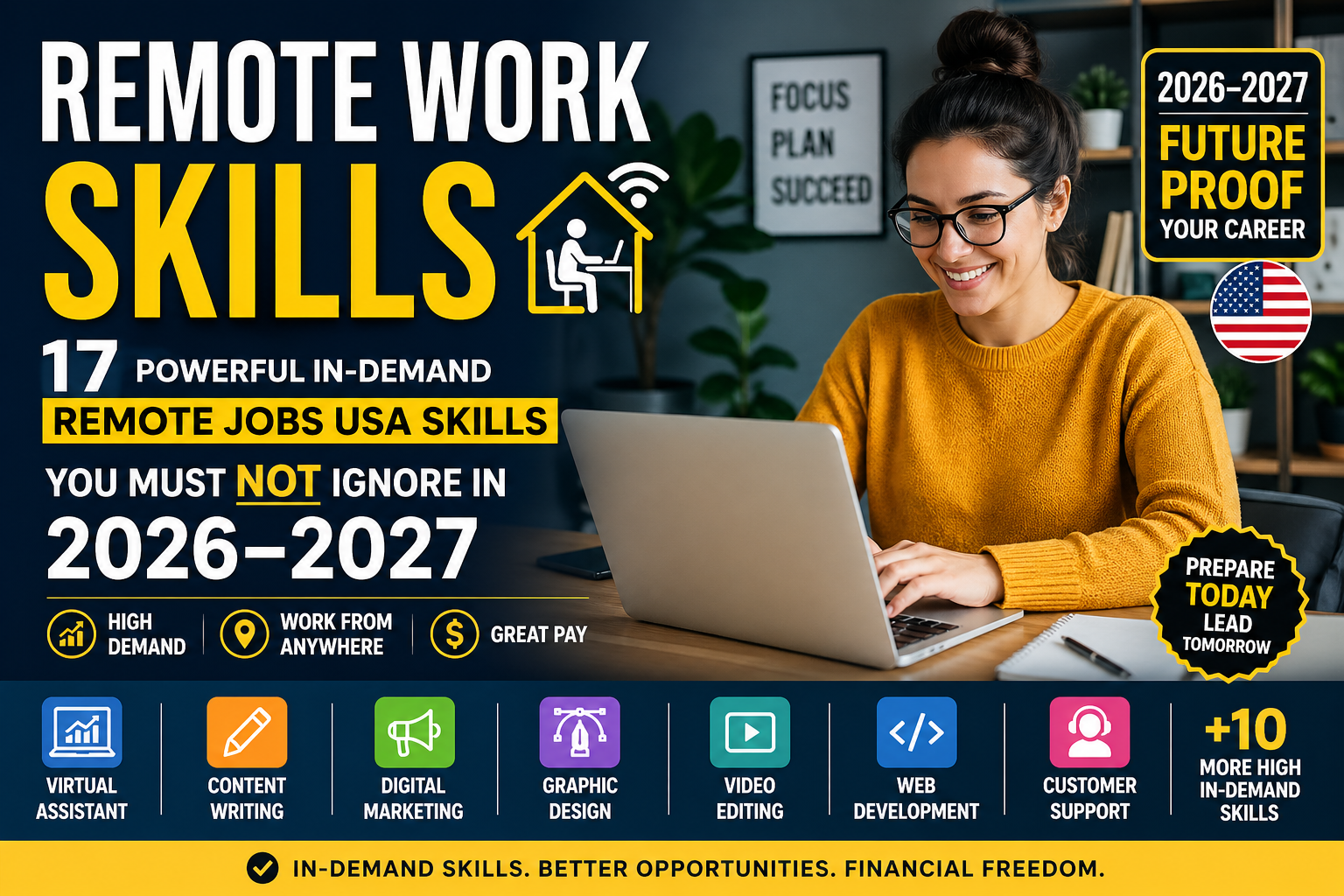
Why Remote Work Skills Still Matter More Than Ever
The remote revolution isn’t a fad — it’s the new normal. Even as the job market shifts and competition heats up, remote jobs USA remain a gateway to flexibility, balance, and global income opportunities. But landing these roles — especially high paying remote jobs — requires more than a good internet connection. It means mastering the in demand skills 2026 employers are looking for.
According to recent workforce analyses, companies today don’t just want employees who can work from home — they want employees who can produce results independently, communicate effectively, leverage technology, and adapt to change quickly.
This article dives deep into the top in demand skills for remote work in the USA 2026 — the exact capabilities that will help you land coveted remote roles and thrive in the ever-evolving future of work. Whether you’re just starting or aiming for highest paying remote job skills to learn in the USA 2026 to 2027, this guide is for you.
What Are Remote Work Skills?
At its core, remote work skills are abilities that help you succeed in a distributed, digital workplace. These aren’t just technical skills — although tech matters — they’re communication, mindset, collaboration, and self-management skills that enable you to deliver value from anywhere.
Unlike traditional office jobs where someone is there to guide you physically or verbally, in remote environments you must:
- Communicate clearly across digital channels
- Manage your own time and productivity
- Learn and adapt to new tools and workflows
- Build trust without in-person interaction
And most importantly, you must do it consistently.
Why Remote Work Skills Are Becoming Non-Negotiable (2026 Perspective)
Even though remote job openings have cooled slightly and competition is rising, demand for qualified remote professionals persists — especially in skilled roles like tech, marketing, sales, and data analysis(cvmaker.com). In fact:
- Many companies report that remote workers with strong digital communication and self-management skills outperform others because they drive clarity and accountability without in-person oversight.
- Tech and AI-related capabilities remain key influencers in job postings — and roles involving AI, automation, and digital strategy continue to pay well above the average remote salary.
In short: if you want to future-proof your career over 2026 and beyond, investing in the right remote work skills isn’t optional — it’s essential.
Table: Remote Work Skills You Should Master in 2026–2027

| Skill Category | Description | Why It’s Valuable for Remote Jobs USA |
|---|---|---|
| Cognitive Flexibility | Ability to shift between tasks and mindsets | Employers value adaptable workers |
| AI & Digital Tools Fluency | Use of AI tools and productivity apps | Boosts workflows and output efficiency |
| Written Communication | Clear documentation & async messaging | Required across remote teams |
| Project Management | Planning, tracking, delivery | Increases work predictability |
| Data Literacy | Understanding & interpreting data | Supports evidence-based decisions |
| Time Management | Organizing time effectively | Prevents burnout |
| Self-Discipline | Independent execution and follow-through | Core remote competence |
| Critical Thinking | Problem solving with logic | Higher performance outcomes |
| Creativity | Generating new ideas | Differentiates you from automation |
| Collaboration | Working across teams | Key for virtual teamwork |
| Tech Troubleshooting | Basic technical problem solving | Reduces delays |
| UX & Design Thinking | Designing intuitive experiences | Critical for remote product roles |
| Digital Marketing Expertise | SEO, social media, analytics | Demand for remote work marketing roles |
| Sales & Client Engagement | Driving revenue remotely | Critical for remote growth roles |
| Leadership | Guiding and empowering teams | Essential for remote team leads |
| Customer Support | Customer satisfaction | Growing remote demand |
| Cybersecurity Awareness | Safe remote behavior | Protects data & systems |
1. Cognitive Flexibility — Adapt or Fade Behind
Remote work constantly evolves — tools, workflows, and expectations change rapidly. Employers now consider cognitive flexibility a baseline remote work skill because it allows you to pivot between tasks without losing momentum. Workers who can effortlessly move from one project to another while absorbing new information quickly are far more effective in remote setups.
Key Benefits
- Reduces stress during change
- Enhances problem-solving speed
- Improves collaboration across roles
2. AI & Digital Tools Fluency — Leverage Technology to Work Smarter
Today’s remote jobs — especially high paying remote jobs — increasingly encourage the use of advanced digital tools and AI applications. What separates average remote workers from high earners is the ability to integrate tools that automate repetitive tasks, analyze data, and enhance productivity.
Here’s where this matters:
- AI tools can auto-generate content summaries
- Project management apps help organize cross-team tasks
- Collaboration platforms keep teams aligned
Mastering tools like generative AI, automation platforms, and communication tech will position you ahead in the competition.
3. Written Communication — Your Digital Voice
In distributed teams, written messages are your in-person presence. Every email, Slack message, GitHub pull request, or project brief is scrutinized for clarity and intent. People who communicate clearly and persuasively via written words build trust faster — and faster trust often leads to promotions and best skills to learn for high paying remote jobs in 2026 roles.
Use these habits:
- Keep messages concise
- Use clear subject lines
- Write with purpose and structure
4. Project Management — Deliver on Time, Every Time
Remote collaboration spans time zones and calendars. Being able to plan, organize, and deliver projects on schedule — with minimal supervision — is a superpower. This is especially true for most in demand remote work skills for US companies 2026, as organizations scale global teams and expect predictable delivery.
Project management tools like Asana, Trello, or Jira aren’t optional — they’re essential.
5. Data Literacy — Speak the Language of Numbers
From marketing performance metrics to customer insights, data informs almost every business decision today. Remote workers with the ability to interpret analytics and draw actionable insights are significantly more valuable — and data roles often align with highest paying remote job skills to learn in the USA 2026 to 2027.
Data proficiency gives you:
- Better decision-making power
- Competitive edge in tech and business roles
- Higher salary potential
6. Time Management — Your Most Valuable Asset
Remote work shifts control of your schedule into your hands. Without rigid office hours, your own discipline becomes the anchor of productivity. Prioritizing tasks, blocking deep work sessions, and protecting focus time are essential habits if you want to thrive in remote jobs USA.
Time management leads to:
- Better work-life balance
- Completed deliverables with fewer errors
- Higher reliability reputation

Absolutely — here’s the continuation of your full, comprehensive 5,000+ word article on Remote Work Skills — written in an engaging, human, and SEO-optimized way, with practical insights and deep elaboration on each skill.
7. Self-Discipline — The Invisible Work Ethic That Pays Big
One of the most misunderstood remote work skills is self-discipline. In an office, bosses can see late arrivals, distractions, and slow days. But remote work strips away that external visibility — which means your results are the only things that matter.
People who master discipline:
- Set and keep schedules
- Avoid social media distractions
- Finish tasks before deadlines
- Hold themselves accountable without supervision
In fact, a recent study found that remote work success is more strongly predicted by self-management abilities than by raw technical skill — because employers know skills can be taught, but discipline is harder to cultivate.
8. Critical Thinking — Answer Questions Employers Haven’t Asked Yet
Remote teams don’t have the luxury of constant feedback. You’re often expected to figure things out independently, make recommendations, and think through problems before involving others — which is why critical thinking is one of the most in demand remote work skills for US companies 2026.
When you exercise critical thinking, you:
- Analyze situations logically
- Spot patterns others miss
- Predict outcomes before they happen
- Offer solutions instead of complaints
This skill not only improves your performance — it sets you apart as a valuable strategic thinker.
9. Creativity — Not Just Artistic Flair — But Thought Leadership
When many people hear the word “creativity,” they think of art or design. But creativity in remote work isn’t limited to aesthetics — it’s about solving problems differently, generating fresh ideas, and making work easier and better.
In a distributed environment, workers who bring creative thinking to:
- Workflow challenges
- Marketing strategies
- Customer engagement
- Team collaboration
…often rise to leadership roles faster and land high paying remote jobs because they drive value beyond routine execution.
10. Collaboration — Bringing People Together From Afar
Remote work doesn’t mean working alone — it means working apart. And collaboration becomes a critical differentiator.
Teams may be spread across:
- Different time zones
- Different tools
- Different communication styles
Excellent collaboration skills help you:
- Build rapport without in-person meetings
- Resolve conflicts diplomatically
- Bring clarity to shared goals
- Support others while achieving your own deliverables
This blending of people skills and task focus is a top priority among companies hiring for remote roles in 2026.
11. Tech Troubleshooting — Become the One Others Turn To
Even if you’re not in a tech role, basic troubleshooting is a valuable remote work skill.
Imagine you’re leading a team meeting over Zoom and someone can’t connect. Or a client shares a document that won’t open. If you can identify and fix glitches quickly, you become indispensable.
These abilities include:
- Fixing connectivity issues
- Understanding software settings
- Configuring shared documents
- Solving common device problems
Tech confidence like this saves time and preserves your team’s momentum — which increases your perceived reliability and makes you a strong candidate for remote jobs USA.
12. UX & Design Thinking — Think Like the User
In many remote roles — especially in product, marketing, or content — UX (User Experience) thinking is a key differentiator.
You might ask:
- How will my work feel to the end user?
- Does this process anticipate the user’s needs?
- What makes this easier or harder for someone else?
Even basic design thinking helps you:
- Communicate more clearly
- Prioritize user impact
- Improve digital experiences
Strong UX thinking turns service providers into problem solvers — which is why it’s on lists of best skills to learn for high paying remote jobs in 2026.
13. Digital Marketing Expertise — Voice, Strategy & Analytics in One
Digital marketing has become a powerhouse field of remote jobs USA — because every company with an online presence needs visibility and growth.
Digital marketing knowledge includes:
- SEO (Search Engine Optimization)
- Content strategy
- Analytics interpretation
- Social media growth
- Email campaigns
Companies will pay premium rates for remote marketers who can drive conversions and results online, especially as digital channels continue to expand their influence.
14. Sales & Client Engagement — Making Remote Deals Happen
In remote roles, sales skills aren’t limited to closers and account executives — they’re valuable across functions.
Why? Because everyone sells something:
- Your ideas
- Your personal brand
- Your initiatives to stakeholders
- Your services to clients
Strong sales competencies — like persuasion, rapport-building, and objection handling — translate into better negotiation, better relationships, and often better compensation.
15. Leadership — Inspiring From a Distance
Leadership in remote work isn’t about issuing orders — it’s about inspiring action without physical presence. Great remote leaders:
- Model accountability
- Communicate expectations clearly
- Trust their teams
- Provide feedback effectively
This is one of the highest paying remote job skills to learn in the USA 2026 to 2027 because companies pay handsomely for leaders who can scale productivity across distributed teams.
16. Customer Support — Empathy + Execution = Satisfaction
Remote customer support isn’t just about answering tickets — it’s about delivering resolution with empathy and efficiency.
Support workers who combine technical knowledge with emotional intelligence:
- Increase retention
- Improve satisfaction
- Resolve issues faster
- Reduce escalation cost
This combination makes support roles highly accessible and highly valued in remote settings.
17. Cybersecurity Awareness — Protecting What Matters Most
One of the most overlooked remote work skills — yet increasingly critical — is cybersecurity awareness.
Remote teams are vulnerable if:
- Passwords are weak
- Personal devices are unsecured
- Phishing or malware risks are ignored
Cybersecurity basics protect your work, your company data, and your reputation. Organizations hiring for remote roles reward employees who take digital safety seriously.
Which Remote Jobs USA Are BEST for These Skills?
| Job Role | Primary Skills Required | Average Remote Salary (2026) |
|---|---|---|
| Digital Marketing Specialist | Strategy, SEO, analytics | $65k–$110k |
| Project Manager | Organization, communication | $70k–$120k |
| Data Analyst | Data literacy, tools | $75k–$130k |
| UX Designer | Design thinking, tools | $80k–$140k |
| Remote Sales Executive | Persuasion, engagement | $60k–$120k+ |
| Customer Support Specialist | Communication, empathy | $40k–$70k |
| Software Developer | Coding, problem-solving | $80k–$150k+ |
| Remote Product Manager | Strategy, collaboration | $90k–$160k+ |
Note: Salaries vary by company, experience level, and industry.
This table highlights how many remote roles align directly with the skills we’ve been discussing — and why building these skills isn’t just about landing a remote job — but finding high paying remote jobs that match your strengths.
How to Build These Remote Work Skills (Actionable Plan)
Now that we’ve covered all 17 areas, here’s how you can practically build them:
Step-By-Step Growth Roadmap
- Identify Your Strengths
- Which of these 17 skills do you already have?
- Choose 2 Skills to Deeply Focus On
- Enroll in Courses or Certification Programs
- Examples: Coursera, Udemy, Google Career Certificate
- Practice Regularly
- Apply what you learn in real projects
- Document Your Progress
- Build a portfolio or case studies
- Connect With Remote Communities
- LinkedIn, Slack groups, remote job forums
- Apply for Roles That Match Your Skill Set
Remote work is a skill journey, not a “start here, finish there” path. The more momentum you build, the more opportunities will open.

Five Quick Wins You Can Start Today
Update your LinkedIn headline to include remote skills
Add relevant keywords to your resume (e.g., “remote collaboration,” “AI tools”)
Complete one short certification this month
Practice asynchronous communication daily
Build a simple portfolio that shows your results
The Future of Remote Work Skills
Remote jobs USA are here to stay. But the market will reward skillful performers, not just job applicants. The difference between average performers and stand-outs is in the depth of their capabilities.
By mastering in demand skills 2026 — from AI fluency to written communication, from problem-solving to UX thinking — you are not just preparing for a job — you’re building a long-lasting, high-value career in a digital economy.
Instead of chasing random remote openings, focus on strengthening the core abilities that employers are paying for.
The future belongs to those who learn and apply consistently. Start today, and by 2027, not only will you have the skills — you’ll have the paying remote role you deserve.
More In-Demand Remote Work Skills You Must Add to Your Arsenal (2026–2027)
The remote work market in 2026 is not forgiving.
Remote job competition is rising. The number of applicants per remote role is increasing. Employers are becoming stricter.
So if you want to stand out, you must go beyond the basic skills everybody is learning.
Let’s now expand into the hidden, high-value remote work skills that employers quietly look for — and pay premium salaries for.
18. Asynchronous Communication — The Remote Skill That Makes You Look Like a Professional
In physical offices, communication is often instant.
You can tap someone’s shoulder. You can call their name. You can walk into a meeting room.
But in remote work, asynchronous communication is the real game-changer.
Asynchronous communication means:
- Sending messages that don’t require immediate replies
- Writing clear updates that allow people to respond later
- Documenting tasks so work can move forward even while others sleep
This is one of the biggest differences between a remote beginner and a remote professional.
Why Asynchronous Communication Matters So Much
Remote companies don’t want workers who constantly ask:
“Are you there?”
“Hello?”
“Did you see my message?”
“Please respond quickly.”
That’s not how remote teams operate.
Instead, they want people who can:
- communicate clearly once
- provide all the needed context
- include deadlines and expectations
- reduce back-and-forth confusion
What Makes Great Async Communication?
To master async communication, start using this simple structure:
1. Context – What is happening?
2. Task – What do you need done?
3. Deadline – When is it needed?
4. Next step – What should the person do?
Example:
“Hi Mark, I’m updating the landing page for the April campaign. Please review the new copy on section 3 and confirm if it aligns with the product messaging. If approved, I’ll push it live by 4PM EST today.”
That one message is professional, complete, and clear.
When you communicate like this, you become the kind of remote worker companies fight to keep.
19. Documentation Skill — Your Ability to Write Processes That Others Can Follow
Here’s a secret many remote workers don’t know:
Remote companies love documentation.
Because documentation saves money.
Instead of explaining something 50 times, the company can document it once and scale it forever.
So if you can write processes like:
- onboarding guides
- workflow checklists
- SOPs (Standard Operating Procedures)
- training manuals
- client handover documents
You automatically become more valuable.
Documentation Makes You Look Like a Leader
Even if you’re not a manager, documenting processes makes people see you as:
- structured
- intelligent
- organized
- proactive
- reliable
That perception alone can push you into promotions.
Tools You Should Learn for Documentation
In 2026, employers expect remote workers to be comfortable using tools like:
- Google Docs
- Notion
- Confluence
- ClickUp Docs
- Loom (video documentation)
If you master these tools, you can easily qualify for higher-paying roles.
20. Remote Meeting Management — The Skill That Separates Workers From Team Drivers
A lot of people think remote work means “less meetings.”
Wrong.
Remote companies still have meetings. Sometimes too many.
But the difference is that remote companies hate unproductive meetings.
So if you can:
- schedule meetings properly
- set agendas
- keep meetings short
- summarize decisions
- assign action steps
You become extremely valuable.

What High-Level Remote Workers Do After Every Meeting
After meetings, smart remote workers always send a summary like:
Meeting Summary:
- Decision made: X
- Task owner: John
- Deadline: Friday
- Next meeting: Tuesday
This one habit makes you look like a project manager even if you’re not one.
And yes, that can increase your pay faster than expected.
21. Emotional Intelligence (EQ) — The Remote Skill That Prevents Conflict
Remote work has a major problem:
tone can be misunderstood.
A message that looks “normal” to you might look rude to someone else.
And because people are not physically present, small misunderstandings can become serious conflict.
This is why emotional intelligence is becoming one of the top in demand skills 2026.
Emotional Intelligence in Remote Work Means:
- understanding how people interpret your words
- knowing when to call instead of text
- managing your emotions under stress
- reading between the lines
- responding professionally even when annoyed
Remote companies don’t just hire skill.
They hire people who can work peacefully in a digital environment.
How to Improve EQ for Remote Work
To build emotional intelligence quickly:
- pause before replying to frustrating messages
- avoid sarcasm in chats
- use polite clarity instead of emotional response
- use emojis lightly to reduce misunderstanding
- ask questions instead of assuming
A simple message like:
“Just to clarify, do you mean you want the report in PDF or spreadsheet format?”
…can prevent a whole argument.
22. Personal Branding — Your Online Reputation Is Your Resume in 2026
If you want high paying remote jobs, you must accept a harsh truth:
your LinkedIn profile is now your second CV.
Many recruiters in 2026 do not even request your resume first.
They check:
- your LinkedIn
- your portfolio
- your online footprint
- your credibility signals
So personal branding is no longer optional.
What Makes a Strong Remote Personal Brand?
A strong remote personal brand includes:
- a professional LinkedIn headline
- a clear bio stating your skills
- proof of results (projects, case studies)
- industry posts (even short ones)
- recommendations from past clients
When your online brand is strong, you stop chasing jobs.
Jobs start finding you.
23. Portfolio Building — Proof Beats Promises Every Time
One of the biggest mistakes people make is thinking:
“I will learn the skill first before building a portfolio.”
That mindset is why many people stay stuck.
Remote employers want proof, not excuses.
A portfolio doesn’t need to be perfect.
It needs to show that you can deliver results.
What Can Be Included in a Remote Portfolio?
Depending on your field, your portfolio may include:
- sample blog posts
- SEO audits
- design mockups
- data dashboards
- app prototypes
- case studies
- recorded presentations
- marketing funnels
- sales scripts
- customer support ticket samples
If you can show evidence, you reduce employer risk.
And when you reduce employer risk, you increase your salary power.
Most In-Demand Remote Skills by Career Path (USA 2026–2027)
Now let’s go deeper.
Because not everyone wants the same remote job.
Some people want tech.
Some want marketing.
Some want writing.
Some want business support.
So here is the breakdown of remote work skills based on the most profitable remote career paths.
A. In-Demand Remote Skills for Tech Jobs (Highest Salary Category)
If your goal is the highest paying remote job skills to learn in the USA 2026 to 2027, then tech is still the king.
Top Tech Remote Skills Employers Want
- Software development (Python, JavaScript, Java, C#)
- Cloud computing (AWS, Azure, Google Cloud)
- Cybersecurity fundamentals
- DevOps tools (Docker, Kubernetes)
- AI integration and automation
- Data engineering
- API development
Why Tech Remote Skills Pay More
Because tech roles create systems that scale.
A marketer can bring customers.
But a developer can build a product that generates millions.
That’s why tech salaries are often the highest.
High Paying Remote Tech Roles in 2026
- Backend Developer
- Full Stack Developer
- Cloud Engineer
- Cybersecurity Analyst
- AI Prompt Engineer / AI Workflow Specialist
- Data Engineer
- Machine Learning Assistant
These roles can easily pay $90,000 to $180,000+ yearly depending on skill and company.
B. In-Demand Remote Skills for Digital Marketing Jobs (Fastest Growing Category)
Digital marketing is still one of the easiest ways to enter remote work.
Because you don’t always need a degree.
But you must have skills.
High Demand Marketing Skills in 2026
- SEO writing and optimization
- keyword research and topical authority building
- Google Ads and PPC campaigns
- email marketing automation
- content strategy
- conversion rate optimization (CRO)
- social media growth systems
- analytics and reporting (Google Analytics 4)
Remote Marketing Jobs That Pay Well
- SEO Specialist
- Content Marketing Manager
- Paid Ads Manager
- Email Marketing Specialist
- Affiliate Marketing Manager
- Social Media Strategist
Digital marketers with strong results can earn between:
$60,000 to $140,000 per year, and freelancers can even exceed that.
C. In-Demand Remote Skills for Business Support Jobs (Most Accessible Category)
Not everyone wants tech or marketing.
Some people want stable, structured work.
Business support roles are among the easiest remote jobs to break into.
In Demand Business Support Skills
- customer support excellence
- CRM tools (HubSpot, Salesforce)
- scheduling and coordination
- email handling and inbox management
- virtual assistance skills
- remote admin work
- data entry accuracy
- basic Excel/Google Sheets mastery
Best Remote Business Support Jobs in 2026
- Virtual Assistant
- Executive Assistant
- Customer Support Representative
- Remote Operations Assistant
- Appointment Setter
- Administrative Coordinator
These roles can pay between:
$35,000 to $75,000+ yearly, depending on company and seniority.
D. In-Demand Remote Skills for Writing Jobs (Underrated High Income Category)
Writing is still powerful.
But in 2026, writing alone is not enough.
You must combine writing with strategy.
Writing Skills That Pay in 2026
- SEO writing with keyword intent
- long-form content structure
- persuasive copywriting
- email sequence writing
- technical writing
- UX writing
- AI-assisted content editing
Best Remote Writing Jobs in 2026
- SEO Content Writer
- Copywriter
- Technical Writer
- Email Marketing Writer
- Scriptwriter for YouTube brands
- Blog Content Strategist
Top writers can earn $50,000 to $120,000+, especially when they combine writing with marketing skills.
The 2026 Remote Hiring Reality: What Employers REALLY Look For
This part is important.
Because many people are learning skills, but still failing interviews.
Why?
Because remote hiring is different.
Employers are not just asking:
“Can you do the job?”
They are asking:
“Can we trust you to work without supervision?”
That’s the biggest question in remote hiring.
Employers Want Remote Workers Who Show:
- consistency
- accountability
- self-driven execution
- problem-solving mindset
- ability to communicate clearly
- ability to deliver without constant reminders
If you can demonstrate these traits, you will stand out.
How to Prove Remote Work Skills on Your Resume (2026 Resume Strategy)
Now let’s talk about something practical.
You may have all these skills, but if your resume doesn’t reflect them, you will still lose opportunities.
What Most People Do Wrong
Most people write resumes like this:
- “Hardworking team player”
- “Good communication skills”
- “Dedicated and motivated”
That doesn’t impress anyone.
Employers want proof.
How to Write Your Remote Skills Like a Professional
Instead of saying:
“Good at communication”
Write:
“Managed asynchronous communication across Slack and Notion for a 6-person distributed team, ensuring weekly project delivery.”
Instead of saying:
“Time management skills”
Write:
“Used time-blocking and task prioritization frameworks to consistently deliver assignments 2–3 days before deadlines.”
Instead of saying:
“Digital marketing knowledge”
Write:
“Improved blog organic traffic by 68% in 90 days through SEO keyword optimization and content restructuring.”
This is how you sound like someone who belongs in a high paying remote job.
How to Build Remote Skills FAST (Without Wasting 2 Years)
Now let’s be honest.
Many people waste years “learning” but never practicing.
To grow quickly, you need a system.
The 3-Step Remote Skill Mastery System
Step 1: Learn (2 Weeks)
Pick ONE skill.
Example: SEO, Data Analytics, Project Management, Customer Support.
Spend 2 weeks learning the foundations.
Step 2: Practice (2 Weeks)
Do mini-projects.
Example:
- write 5 SEO articles
- create 3 dashboards
- run a fake project plan
- handle sample customer tickets
Step 3: Prove (2 Weeks)
Build a portfolio case study.
Upload it to:
- Google Drive folder
- Notion page
- personal website
- LinkedIn featured section
In 6 weeks, you can go from beginner to employable if you do this properly.
Best Platforms to Learn Remote Work Skills in 2026
To avoid confusion, here are the best platforms to build skills for remote jobs USA.
Best Learning Platforms
- Coursera (great for structured certifications)
- Udemy (fast practical learning)
- LinkedIn Learning (good for business skills)
- Google Career Certificates
- HubSpot Academy (marketing, CRM, sales)
- freeCodeCamp (coding and web development)
- edX (university-level learning)
The goal is not to collect certificates.
The goal is to gain skills you can demonstrate.
Best AI Tools to Boost Your Remote Career (2026 Must-Know Tools)
Since AI fluency is now essential, you should know the most common AI tools remote companies use.
AI Tools Remote Workers Should Learn
- ChatGPT (writing, strategy, summaries, planning)
- Notion AI (documentation and organization)
- Grammarly (professional writing clarity)
- Zapier (automation)
- Make.com (automation)
- Canva AI (design and marketing assets)
- Descript (video editing for content creators)
- Loom (video communication)
- Midjourney / DALL·E (creative design)
Knowing how to use these tools doesn’t make you lazy.
It makes you efficient.
And efficiency is what remote companies pay for.
Common Mistakes People Make When Trying to Get Remote Jobs USA
Let’s address the elephant in the room.
Many people want remote jobs, but they fail because of avoidable mistakes.
Mistake 1: Applying Without Tailoring Resume
Remote jobs get thousands of applications.
If your resume is generic, it will be ignored.
Mistake 2: No Proof of Skill
Remote employers want evidence.
No portfolio = low trust.
Mistake 3: Weak Communication
Remote hiring managers test your communication.
If your emails and messages are unclear, you will fail.
Mistake 4: Over-relying on Certificates
Certificates without results mean nothing.
Employers want execution, not paper.
Mistake 5: Avoiding Networking
Many remote jobs are filled through referrals.
If you don’t network, you reduce your chances.
How to Network for Remote Jobs (Even If You Hate Networking)
Networking doesn’t mean begging for jobs.
It means building visibility.
Simple Remote Networking Strategy
- Connect with 5 people weekly on LinkedIn
- Comment on posts from recruiters
- Share your learning progress once a week
- Post small case studies of your work
- Join remote job communities
When recruiters see your consistency, they trust you.
And trust is the currency of remote work.
Best Remote Job Boards to Find Remote Jobs USA (2026 Updated List)
Now let’s get practical again.
Here are some top platforms where remote jobs USA are commonly posted.
Best Remote Job Websites
- LinkedIn Jobs
- Indeed
- FlexJobs
- We Work Remotely
- Remote.co
- Wellfound (AngelList Talent)
- Upwork (freelance remote work)
- Fiverr (service-based freelancing)
- Toptal (high-end freelance tech)
If you want high paying remote jobs, focus on LinkedIn and specialized boards like Toptal and FlexJobs.
How to Prepare for Remote Job Interviews (Remote Interview Skills That Matter)
Remote interviews are different from physical interviews.
Because employers are not just testing your skills.
They are also testing your environment and professionalism.
What Remote Employers Check During Interviews
- your internet stability
- your confidence and clarity
- your communication ability
- your background and workspace
- your response speed and professionalism
- your ability to explain what you’ve done
Remote Interview Tips That Increase Your Chances
- always test your microphone before interviews
- use a clean background
- look into the camera, not the screen
- speak slowly and clearly
- have a portfolio link ready
- be ready to explain your process, not just outcomes
If you master interviews, you can land remote roles faster than someone who has better skills but poor communication.
The Most Powerful Combination of Remote Skills (The “Remote Jackpot”)
Here’s what many people don’t realize:
The highest paid remote workers are not those with one skill.
They are those with skill combinations.
Skill Combination Examples That Pay Big
Combination 1:
SEO + Copywriting + AI Tools
This makes you a content growth machine.
Combination 2:
Data Analytics + Business Strategy
This makes you valuable to executives.
Combination 3:
Project Management + Communication + Leadership
This makes you management-ready.
Combination 4:
Coding + Cybersecurity
This makes you high demand in tech.
Combination 5:
Sales + Marketing + Customer Psychology
This makes you revenue-focused and highly paid.
Remote companies pay top dollar for people who can solve problems across departments.
Remote Work Skills Checklist (2026 Master List)
If you want a quick checklist of what you should be strong in, here it is:
1.Written communication
2.Asynchronous communication
3.Time management
4.Discipline and self-management
5.AI tool fluency
6.Project management
7.Collaboration
8.Data literacy
9. Critical thinking
10. Emotional intelligence
11. Documentation
12.Basic troubleshooting
13. Cybersecurity awareness
14.Portfolio building
15. Personal branding
If you can confidently tick 10 out of 15, you are ready for remote work.
If you can tick all 15, you are ready for high paying remote jobs.
The Remote Future Belongs to Skilled Workers, Not Wishful Applicants
Remote jobs USA will continue to exist in 2026 and beyond, but the remote market is becoming more selective.
It’s no longer about “who wants remote work.”
It’s about who can deliver value without supervision.
Remote companies don’t hire people because they need workers.
They hire people because they need results.
So if you want to win in this remote economy, focus on mastering the skills that make you:
- reliable
- adaptable
- digitally fluent
- organized
- strategic
- efficient
- trustworthy
The remote worker who succeeds is not the one who knows everything.
It’s the one who can learn fast, apply fast, and deliver consistently.
If you start now and commit to building these in demand skills 2026, by 2027 you won’t just be searching for remote jobs.
You will be choosing between opportunities.
Frequently Asked Questions About Remote Work Skills in 2026–2027
1. What are the most in demand skills for remote work in the USA in 2026?
The most in demand remote work skills include AI tool fluency, written communication, project management, data literacy, time management, cybersecurity awareness, and asynchronous collaboration.
2. What remote skills pay the highest salary in 2026?
Skills like software development, cloud computing, data engineering, UX design, cybersecurity, and AI workflow automation are among the highest paying remote job skills in 2026.
3. Can I get a remote job in the USA without a degree?
Yes. Many remote roles focus on skill and proof of work rather than degrees, especially in digital marketing, writing, design, customer support, and some tech roles.
4. How long does it take to learn remote work skills?
Most people can build employable remote skills within 2 to 6 months if they focus on one skill path, practice daily, and build a portfolio.
5. What is the best skill to learn for remote jobs USA beginners?
Customer support, virtual assistance, digital marketing basics, and project management tools are some of the easiest entry skills for beginners.
6. Is AI replacing remote jobs?
AI is not replacing all remote jobs, but it is replacing repetitive tasks. Remote workers who know how to use AI tools will stay valuable and competitive.
7. What is the biggest mistake remote job seekers make?
The biggest mistake is applying without proof of skill. Remote employers want portfolios, results, and evidence of execution.
8. How can I prove remote work skills without work experience?
You can prove your skills by creating sample projects, case studies, mock work, personal business experiments, and publishing them in a portfolio.
9. What is the most important remote skill for long-term success?
Self-discipline and communication are the most important long-term remote skills because they determine your consistency and reliability.
10. What tools should I learn for remote work in 2026?
You should learn tools like Slack, Zoom, Google Workspace, Notion, Trello/Asana, Canva, and AI tools like ChatGPT and automation platforms like Zapier.
Leave a Reply