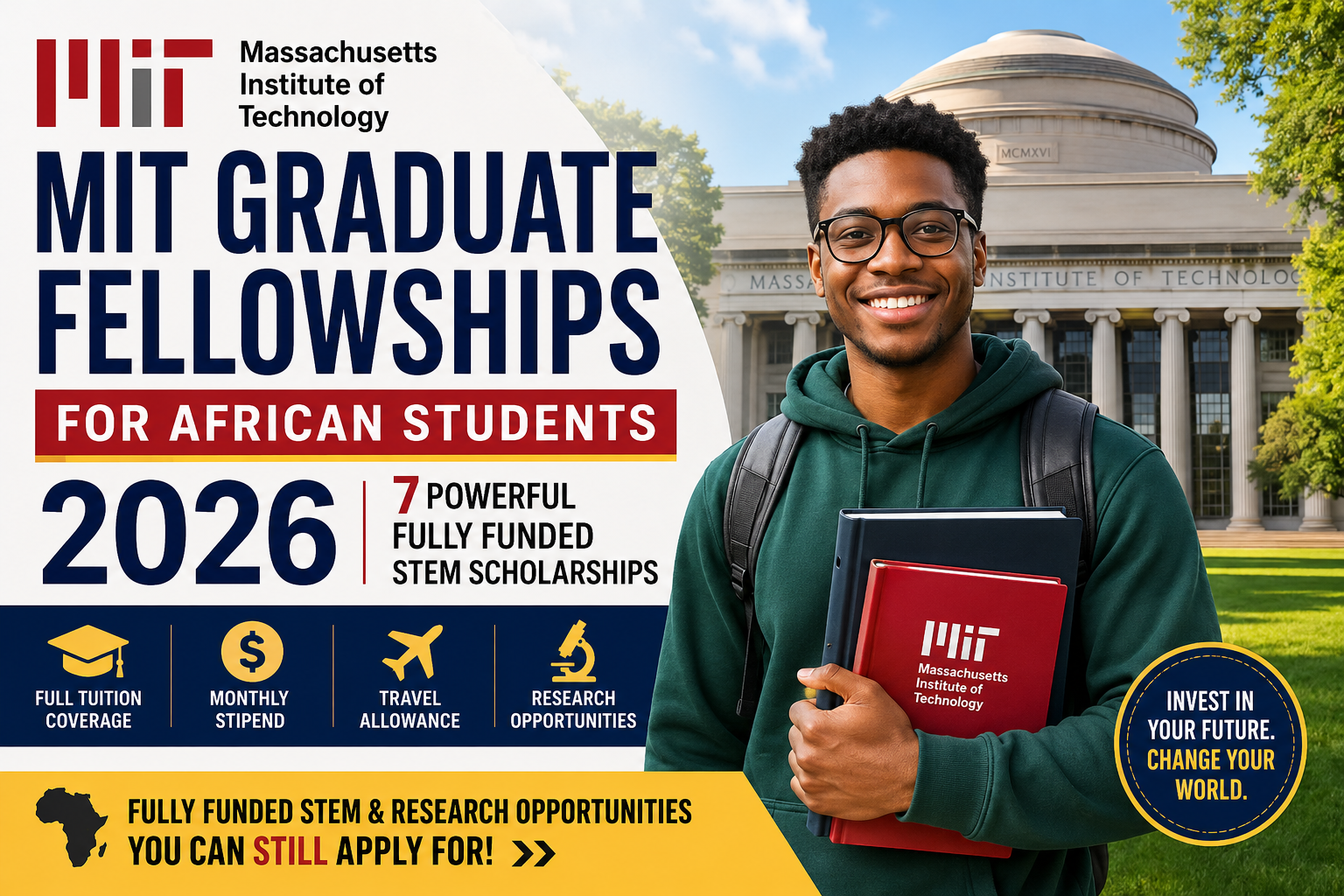
For many African students, studying at the Massachusetts Institute of Technology once felt like a distant dream reserved for only the world’s elite. MIT has long carried a reputation for producing groundbreaking scientists, engineers, innovators, and entrepreneurs. Yet what many students across Africa still do not realize is that there are several MIT Graduate Fellowships and fully funded opportunities specifically designed to support outstanding international talent.
The global demand for African researchers, AI specialists, climate innovators, biomedical scientists, and engineering experts is growing rapidly. Universities in the United States are increasingly investing in students from Africa because they bring unique perspectives, resilience, and innovative problem-solving skills to global research.
That is exactly why searches for Fully Funded Scholarships 2026, African Student Scholarships, and STEM Scholarships USA are trending heavily heading into 2026 and projected to remain popular through 2027.
If you are an African student hoping to study in the United States without drowning in tuition debt, this guide may completely change your academic future.
In this article, you will discover:
- The best MIT fellowship opportunities for African students
- Fully funded STEM and research programs available in 2026
- Application strategies that improve acceptance chances
- Hidden funding opportunities many applicants overlook
- How MIT evaluates international applicants
- Common mistakes African students make during applications
- How to prepare a winning research proposal
By the end, you will understand exactly how to apply for MIT Research Fellowships 2026 and position yourself competitively.

Why MIT Graduate Fellowships Are Becoming More Popular Among African Students
The appeal of MIT is obvious. It consistently ranks among the best universities globally for engineering, technology, artificial intelligence, economics, and scientific innovation.
But beyond prestige, the major attraction is funding.
Graduate education in the United States can cost between $40,000 and $100,000 annually when tuition, housing, health insurance, and living expenses are combined. For most families across Africa, this cost is unrealistic.
This is why MIT Graduate Fellowships for African Students 2026 are attracting massive attention online.
Unlike standard scholarships, fellowships often provide:
- Full tuition coverage
- Monthly stipends
- Research grants
- Travel funding
- Conference sponsorships
- Health insurance
- Housing support
- Academic mentorship
Some fellowships even pay students to conduct research while studying.
MIT also operates within a broader ecosystem of U.S. research funding agencies and foundations that actively support international STEM students.
MIT Graduate Fellowships for African Students 2026: What Makes Them Different?
One reason MIT stands out among other American universities is its research-driven funding culture.
At many institutions, scholarships are limited and highly competitive. At MIT, funding is deeply integrated into the graduate system itself.
This means:
- Departments often finance students directly
- Professors recruit students into funded labs
- Research assistantships can cover nearly all expenses
- External foundations collaborate with MIT
- Graduate fellowships are linked to innovation projects
MIT prioritizes students capable of contributing to research breakthroughs.
That is why African students in fields like:
- Artificial Intelligence
- Climate Technology
- Biotechnology
- Robotics
- Electrical Engineering
- Data Science
- Public Health Technology
- Renewable Energy
- Aerospace Engineering
have increasingly strong opportunities.
7 Powerful MIT Graduate Fellowships African Students Should Watch in 2026
1. MIT Presidential Fellowship Program
The Presidential Fellowship is one of the most prestigious MIT Graduate Fellowships available.
It supports exceptional graduate students during their first academic year and provides substantial financial support.
What It Covers
- Full tuition
- Living stipend
- Health insurance
- Research support
Why It Matters for African Students
African students with strong academic records and leadership potential are increasingly competitive for this fellowship, especially in STEM-related disciplines.
Students with:
- Published research
- International awards
- Tech startup experience
- Innovation projects
- Community impact initiatives
often stand out.
2. Knight-Hennessy Scholars (Stanford + MIT Collaborations)
Although based at Stanford, some collaborative MIT-linked research opportunities intersect with Knight-Hennessy initiatives.
This fellowship remains one of the strongest Fully Funded Scholarships 2026 opportunities globally.
Benefits
- Full graduate funding
- Leadership training
- Networking opportunities
- Travel grants
- Innovation programs
African applicants with interdisciplinary STEM interests are strongly encouraged to apply.
3. MIT Legatum Fellowship
The Legatum Fellowship is particularly relevant for African entrepreneurs and innovators.
It supports students interested in:
- Development innovation
- Entrepreneurship
- African economic transformation
- Social impact technology
Key Advantage
The fellowship values real-world impact, not just academic perfection.
Students building:
- Agricultural technology solutions
- Fintech startups
- Health innovations
- Sustainability projects
can become highly competitive.
4. NSF Graduate Research Fellowship Opportunities
While the National Science Foundation primarily supports U.S. citizens, some MIT-associated labs funded through NSF grants indirectly support international students.
This creates research assistantship opportunities many African students overlook.
Fields With Strong Funding
| STEM Field | Funding Demand Level | Research Opportunities |
|---|---|---|
| Artificial Intelligence | Very High | Extensive |
| Robotics | High | Extensive |
| Climate Science | Very High | Growing |
| Biomedical Engineering | High | Extensive |
| Renewable Energy | Very High | Expanding |
| Quantum Computing | Medium | Competitive |
5. MIT Sloan Fellowships for Innovation and Leadership
Students interested in technology management, innovation policy, and entrepreneurship should closely watch Sloan-related fellowships.
These opportunities are ideal for:
- Startup founders
- Engineers moving into leadership
- African tech innovators
- Future policy leaders
The African startup ecosystem is receiving growing global attention, making this category increasingly important.
6. Research Assistantships (RA Positions)
This is perhaps the most underrated path to studying at MIT fully funded.
Many students focus only on scholarships while ignoring funded research positions.
Why Research Assistantships Matter
Professors often recruit graduate students directly into funded research labs.
Once accepted:
- Tuition may be fully covered
- Students receive monthly salaries
- Additional conference funding may be available
This route is especially important for:
- PhD applicants
- Research-heavy master’s programs
- STEM-focused candidates
7. External STEM Scholarships USA Linked to MIT Opportunities
Several global organizations support African students studying at institutions like MIT.
These include:
- Mastercard Foundation Scholars Program
- Fulbright Foreign Student Program
- AAUW International Fellowships
- Joint Japan/World Bank Scholarships
These external awards can complement MIT departmental funding.
STEM Scholarships USA: Why African Students Have a Stronger Chance in 2026
The global STEM race is accelerating.
Countries are investing heavily in:
- Artificial intelligence
- Renewable energy
- Semiconductor research
- Biotechnology
- Climate resilience
- Data infrastructure
African students are increasingly viewed as essential contributors to future innovation ecosystems.
Several factors explain this trend:
1. Africa’s Young Population
Africa has one of the youngest populations globally, creating enormous future talent potential.
2. Rising African Tech Ecosystems
Countries like:
- Nigeria
- Kenya
- Rwanda
- Ghana
- South Africa
have growing innovation sectors attracting international partnerships.
3. Demand for Diverse Research Perspectives
Universities now actively seek students capable of bringing different perspectives into global problem-solving.
How to Apply for MIT Research Fellowships 2026 Successfully
Understanding how to apply for MIT Research Fellowships 2026 is critical because many brilliant students fail due to poor application strategy rather than lack of intelligence.
Step 1: Choose the Right Department Carefully
MIT admissions are heavily department-driven.
Your success often depends on:
- Faculty alignment
- Research fit
- Lab funding availability
Before applying:
- Study departmental websites
- Review faculty research interests
- Read recent publications
Official MIT graduate admissions information can be found through the MIT Graduate Admissions Office.
Step 2: Build a Strong Research Narrative
Many African applicants make the mistake of listing achievements without telling a coherent story.
MIT values:
- Intellectual curiosity
- Research potential
- Problem-solving ability
- Innovation mindset
Your application should answer:
What important problem are you trying to solve?
Step 3: Contact Professors Strategically
Cold emailing professors without preparation rarely works.
Instead:
- Read their recent papers
- Reference specific projects
- Show genuine research alignment
- Ask thoughtful questions
Avoid generic emails.
Step 4: Strengthen Your Statement of Purpose
Your SOP should not sound robotic.
The best applications feel:
- Personal
- Vision-driven
- Research-focused
- Future-oriented
Discuss:
- Challenges overcome
- Research experiences
- Academic goals
- Long-term vision for Africa
Step 5: Highlight Real-World Impact
MIT values action-oriented thinkers.
If you have:
- Built software
- Conducted community projects
- Started initiatives
- Published papers
- Led innovation teams
emphasize them clearly.
Common Mistakes African Students Make When Applying for MIT Graduate Fellowships
Applying Without Research Experience
Even basic research exposure matters.
Students should:
- Participate in academic projects
- Assist lecturers
- Publish small papers
- Join innovation competitions
Ignoring Faculty Fit
A strong GPA alone does not guarantee admission.
Your interests must align with existing MIT research programs.
Weak Recommendation Letters
Generic recommendation letters hurt applications badly.
Strong letters should discuss:
- Research ability
- Critical thinking
- Leadership
- Intellectual independence
Submitting Generic Essays
MIT reviewers read thousands of applications.
Generic writing disappears instantly.
Your story must feel authentic and memorable.
Best Fully Funded Graduate Scholarships in USA for African Students 2026
Beyond MIT, several U.S. graduate opportunities are becoming increasingly relevant.
| Scholarship | Coverage | Best For |
|---|---|---|
| Fulbright Program | Fully Funded | Research & Master’s |
| Mastercard Foundation Scholars | Tuition + Living | African Leadership |
| Knight-Hennessy Scholars | Full Funding | Global Leadership |
| AAUW International Fellowship | Graduate Funding | Women in STEM |
| Joint Japan/World Bank Program | Tuition + Living | Development Studies |
The official fellowship and funding opportunities page at MIT Office of Graduate Education Fellowships provides updated information for graduate applicants.
Why 2026 Could Be the Best Year Yet for African Student Scholarships
Several global trends are converging simultaneously.
Increased International Research Funding
Governments and universities are expanding STEM investments dramatically.
Artificial Intelligence Boom
AI-related graduate funding has surged.
Students with skills in:
- Machine learning
- Data science
- Computer vision
- Robotics
have stronger funding prospects.
Climate and Sustainability Research Expansion
Climate-focused scholarships are growing rapidly.
African students working on:
- Energy access
- Agricultural resilience
- Climate adaptation
may have significant opportunities.
Fully Funded MIT STEM Scholarships for African Students: What Selection Committees Really Want
Selection committees often look beyond grades.
They want students capable of:
- Leading innovation
- Conducting impactful research
- Solving global problems
- Collaborating internationally
Traits That Stand Out
Intellectual Curiosity
Students who genuinely love learning often perform best.
Research Initiative
Independent projects matter enormously.
Vision
Applicants with clear long-term goals are more compelling.
Persistence
Many successful applicants overcame difficult conditions.
How African Students Can Become More Competitive Before Applying
Build Technical Skills
Focus on:
- Programming
- Research methods
- Data analysis
- Scientific writing
Publish Something
Even small publications can help significantly.
Options include:
- Undergraduate journals
- Conference abstracts
- Technical blogs
- Research collaborations
Join International Communities
Participate in:
- Hackathons
- Online fellowships
- Research internships
- Open-source projects
The Emotional Reality Behind Applying to MIT
Many students quietly battle:
- Self-doubt
- Financial anxiety
- Fear of rejection
- Imposter syndrome
This is completely normal.
The application process can feel overwhelming, especially when competing globally.
But many African students underestimate how valuable their experiences truly are.
Resilience itself is often an extraordinary strength.
Students who have solved problems in difficult environments frequently become exceptional innovators later.

MIT Graduate Fellowships Application Timeline 2026: Important Deadlines African Students Must Not Miss
One of the biggest reasons talented applicants lose out on MIT Graduate Fellowships is surprisingly simple: poor timing.
Every year, thousands of students begin preparing too late. Some rush their applications within a few weeks, while others miss critical fellowship deadlines entirely because they assumed scholarship applications happen separately from admission applications.
The truth is that most MIT Graduate Fellowships for African Students 2026 are closely tied to the graduate admission process itself. In many cases, once you apply for admission, you are automatically considered for departmental funding and fellowships. However, timing still matters enormously because late preparation can weaken every part of your application.
For African students targeting Fully Funded Scholarships 2026 and competitive STEM Scholarships USA, creating a realistic timeline may be the difference between rejection and acceptance.
This section breaks down the ideal MIT fellowship preparation schedule month by month so you can stay ahead of deadlines and avoid costly mistakes.
Why Early Preparation Matters for MIT Graduate Fellowships
MIT is not only evaluating grades.
The admissions committee also looks at:
- Research potential
- Academic consistency
- Technical preparation
- Leadership qualities
- Innovation mindset
- Long-term goals
Strong applications take time to build.
Students often underestimate how long it takes to:
- Contact referees
- Prepare a statement of purpose
- Refine a CV
- Write research proposals
- Secure transcripts
- Prepare English test scores
- Identify faculty matches
Because of this, successful applicants often begin preparing nearly a year before deadlines.
According to the official MIT Graduate Admissions Office, application requirements and deadlines vary by department, making early planning even more important.
MIT Graduate Fellowships for African Students 2026 Timeline Breakdown
The timeline below is designed specifically for African students planning to apply for graduate STEM programs and research fellowships at MIT in 2026.
| Timeline Period | What You Should Focus On | Why It Matters |
|---|---|---|
| January – March 2025 | Research programs and departments | Helps identify suitable labs and professors |
| April – June 2025 | Build research portfolio and technical skills | Strengthens competitiveness |
| July – August 2025 | Draft SOP and prepare CV | Allows time for revisions |
| September 2025 | Contact referees and professors | Important for strong recommendations |
| October – December 2025 | Submit applications and fellowship materials | Most MIT deadlines fall here |
| January – March 2026 | Interview preparation and funding updates | Some departments conduct interviews |
| April 2026 | Admission decisions released | Funding packages finalized |
| May – August 2026 | Visa processing and relocation planning | Critical for international students |
January to March 2025: Research MIT Programs Carefully
This phase is where smart applicants separate themselves from rushed applicants.
Instead of randomly applying to programs, focus on understanding:
- MIT departments
- Faculty research interests
- Funding opportunities
- Ongoing lab projects
- Fellowship eligibility
Many African students make the mistake of choosing programs based only on rankings.
MIT prefers applicants with strong academic alignment.
For example:
- AI students should identify machine learning labs
- Renewable energy applicants should explore sustainability research groups
- Biomedical engineering students should study ongoing healthcare innovation projects
During this stage:
- Read faculty publications
- Attend online seminars if possible
- Explore research collaborations
- Study graduate student profiles
This helps you write more convincing applications later.
April to June 2025: Strengthen Your Academic and Research Profile
This period should focus on building evidence that you are capable of thriving in a rigorous MIT environment.
For competitive STEM Scholarships USA, applicants benefit enormously from demonstrating:
- Research ability
- Technical competence
- Initiative
- Problem-solving skills
Important Activities During This Phase
Build Technical Skills
Depending on your field, prioritize:
- Python programming
- Data analysis
- Laboratory techniques
- AI and machine learning tools
- Scientific writing
Participate in Research
Even small projects matter.
Options include:
- Assisting university lecturers
- Joining research competitions
- Publishing undergraduate papers
- Completing online research internships
Improve Your Academic Story
If your GPA is not perfect, this phase is your opportunity to strengthen other parts of your application.
MIT values potential, not perfection alone.
July to August 2025: Prepare Your Statement of Purpose and CV
This is one of the most important stages in the entire application journey.
Your Statement of Purpose (SOP) is not just an essay.
It is your academic identity.
The strongest SOPs for MIT Graduate Fellowships for African Students 2026 usually include:
- A compelling personal story
- Research interests
- Academic experiences
- Long-term goals
- Specific MIT alignment
- Future impact vision
Common Mistakes to Avoid
Many applicants:
- Use generic templates
- Focus too much on hardship
- Repeat their CV
- Write emotionally without research focus
MIT wants thinkers and innovators.
Your SOP should show:
what problem you want to solve and why MIT is the ideal place to solve it.
September 2025: Contact Referees and MIT Professors
This stage is critical because recommendation letters often determine whether an application feels credible.
Strong Recommendation Letters Should Discuss:
- Research potential
- Technical ability
- Intellectual independence
- Leadership qualities
- Academic maturity
Avoid requesting recommendation letters at the last minute.
Professors write stronger letters when they have time.
Should You Contact MIT Professors?
For research-based graduate programs, contacting faculty can sometimes improve visibility, especially for PhD applicants.
However, your approach matters.
A strong email should:
- Mention shared research interests
- Reference recent faculty work
- Be concise and professional
- Demonstrate preparation
Avoid generic emails like:
“I want scholarship please supervise me.”
That approach almost never works.
October to December 2025: Submit Your MIT Applications
This is the most intense stage.
Most MIT graduate program deadlines typically fall between:
- November
- December
- Early January
The official fellowship opportunities and funding updates can be monitored through the MIT Office of Graduate Education Fellowships Page.
Documents You Will Likely Need
Academic Documents
- University transcripts
- Degree certificates
- GPA records
Test Scores
Depending on the department:
- TOEFL
- IELTS
- GRE (some programs optional)
Application Materials
- Statement of Purpose
- CV/Resume
- Research proposal
- Writing samples (sometimes)
Recommendation Letters
Usually:
- 2–3 referees
January to March 2026: Prepare for Interviews and Funding Updates
Not all MIT programs conduct interviews, but some research-focused departments do.
During this period:
- Stay active on email
- Respond quickly to requests
- Monitor application portals carefully
Some departments may:
- Request additional documents
- Invite interviews
- Discuss research interests
- Clarify funding arrangements
April 2026: Admission Decisions and Fellowship Offers
This period can be emotionally intense.
Successful applicants typically receive:
- Admission decisions
- Fellowship details
- Funding packages
- Research assistantship information
Funding structures may vary:
- Full fellowships
- Partial fellowships
- Teaching assistantships
- Research assistantships
For many African students, this stage becomes life-changing.
May to August 2026: Visa Preparation and Relocation
Once admitted, the next challenge begins.
International students must prepare:
- U.S. visa applications
- Financial documentation
- Housing arrangements
- Health insurance paperwork
- Travel plans
Start early because visa appointment delays can occur.
Hidden Deadline Mistakes African Students Should Avoid
Waiting Until Final Year Before Preparing
Strong applications often require years of preparation.
Ignoring Time Zone Differences
Some deadlines close based on U.S. time zones.
Missing this detail can cost you an entire application cycle.
Using Generic Scholarship Essays
MIT reviewers can immediately recognize copied or recycled essays.
Underestimating Recommendation Letters
Weak recommendations can quietly destroy otherwise strong applications.
Thoughts on the MIT Graduate Fellowships Timeline 2026
The competition for MIT Graduate Fellowships, Fully Funded Scholarships 2026, and elite African Student Scholarships is intense, but timing gives prepared students a major advantage.
The strongest applicants are rarely the ones who start last minute.
They are usually the students who:
- Plan early
- Build strong research profiles
- Understand faculty alignment
- Refine their applications carefully
- Stay organized throughout the process
For African students hoping to secure Best Fully Funded Graduate Scholarships in USA for African Students 2026, preparation is not just helpful.
It is essential.
And in many cases, the application journey itself becomes the first real step toward becoming a globally competitive researcher, scientist, or innovator.
Final Thoughts on MIT Graduate Fellowships for African Students 2026
The search for MIT Graduate Fellowships, Fully Funded Scholarships 2026, and STEM Scholarships USA is growing because more African students are beginning to realize that elite global education is no longer inaccessible.
The opportunities are real.
But success requires:
- Strategy
- Preparation
- Research alignment
- Persistence
- Authentic storytelling
MIT is not simply searching for perfect grades.
It is searching for thinkers, researchers, innovators, and future problem-solvers capable of changing industries and communities worldwide.
For African students willing to prepare carefully, build strong applications, and pursue research-driven opportunities, 2026 could become a transformational year.
The next breakthrough scientist, AI innovator, climate engineer, or biotech founder from Africa may already be preparing an MIT application right now.
And perhaps, that student is you.
Leave a Reply