Every year, thousands of talented graduates dream of earning a postgraduate degree abroad, yet many abandon that dream after discovering the enormous cost of international education. Tuition fees, accommodation, insurance, airfare, research expenses, and daily living costs can quickly add up to tens of thousands of dollars. For many students, these expenses seem impossible to overcome.
Fortunately, not every world-class education comes with a heavy financial burden.
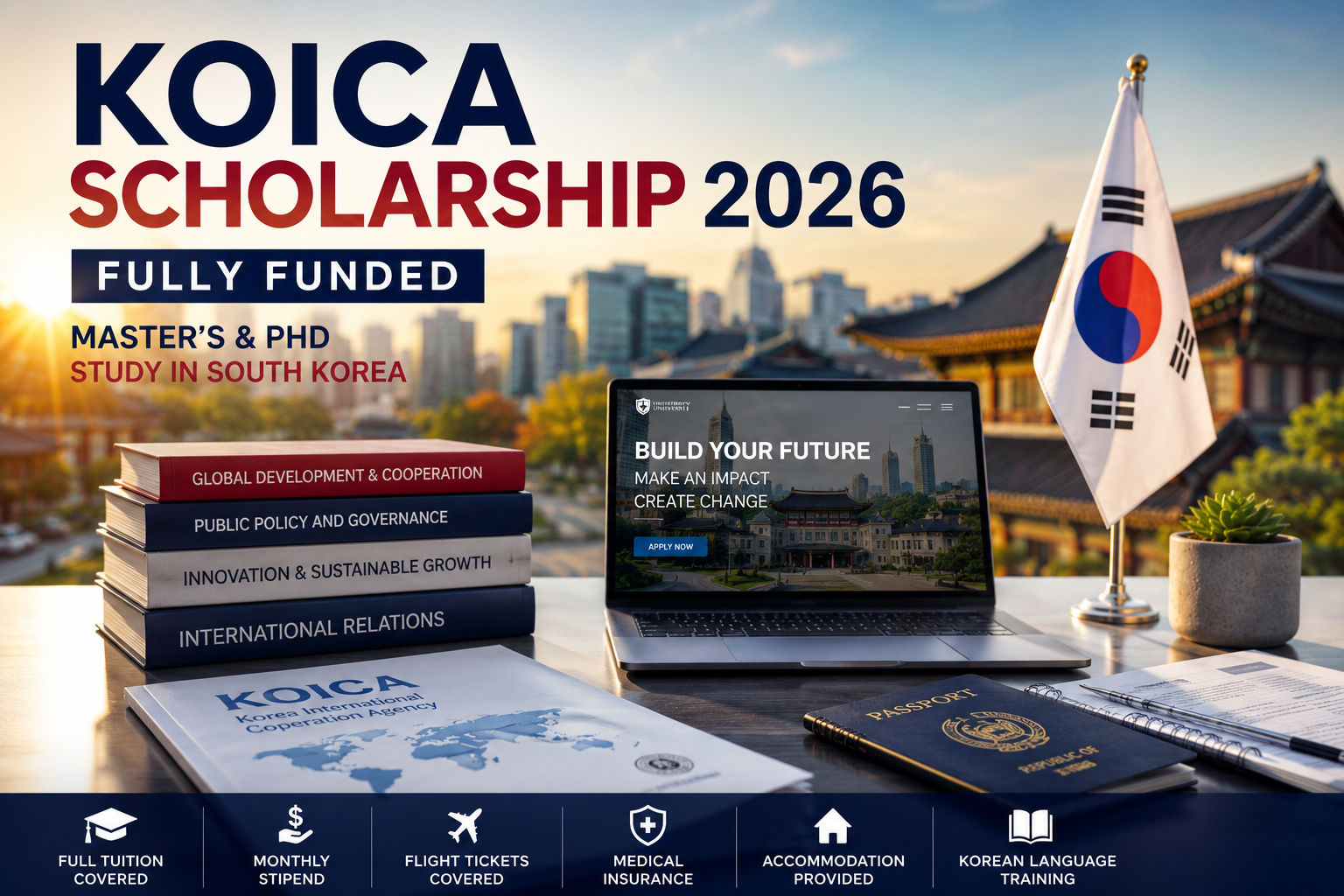
The KOICA Scholarship has become one of the most respected opportunities for professionals from developing countries who aspire to pursue graduate education while building careers that contribute to national development. Unlike many scholarships that only cover tuition, this program offers a comprehensive funding package designed to remove nearly every financial barrier standing between qualified applicants and their academic ambitions.
Beyond financial support, the scholarship opens doors to internationally recognized universities, exposure to advanced technologies, leadership development, cultural exchange, and an influential global network of professionals committed to sustainable development.
If you’re considering pursuing a graduate degree in Asia, few opportunities are as competitive—or as rewarding—as the KOICA Scholarship Program South Korea 2026.
However, winning the scholarship requires far more than simply filling out an application form. Successful applicants understand the selection process, prepare compelling documentation, demonstrate leadership potential, and present themselves as future changemakers.
This comprehensive guide walks you through everything you need to know, including:
- What the scholarship offers
- Eligibility requirements
- Financial benefits
- Required documents
- Application timeline
- Selection process
- Common mistakes to avoid
- Eleven proven strategies that can significantly strengthen your application
Whether you’re planning to pursue a Master’s degree or a PhD, this guide will help you approach your application with confidence and clarity.

KOICA Scholarship 2026 at a Glance
| Feature | Details |
|---|---|
| Scholarship Name | KOICA Scholarship Program |
| Host Country | South Korea |
| Scholarship Type | Fully Funded Government Scholarship |
| Degree Level | Master’s and PhD |
| Funding Organization | Korea International Cooperation Agency (KOICA) |
| Eligible Applicants | Government officials, public sector employees, and selected professionals from partner countries |
| Tuition Coverage | 100% Covered |
| Monthly Living Allowance | Provided |
| Airfare | Round-trip economy ticket included |
| Accommodation | Covered |
| Medical Insurance | Included |
| Korean Language Training | Included (where applicable) |
| Application Route | Through designated government agencies or Korean embassies depending on country |
| Application Period | Varies by participating country |
What Is the KOICA Scholarship?
The KOICA Scholarship is a prestigious international development scholarship funded by the Korea International Cooperation Agency (KOICA), a government agency established to support sustainable development and strengthen partnerships between South Korea and developing countries.
Unlike conventional academic scholarships that primarily reward outstanding grades, the KOICA program focuses on developing future leaders capable of driving meaningful change in their home countries.
Participants receive advanced education in specialized fields while simultaneously acquiring practical leadership experience, international exposure, and professional networks that remain valuable long after graduation.
The scholarship reflects South Korea’s broader commitment to global cooperation. By investing in professionals from partner nations, KOICA aims to promote knowledge sharing, strengthen institutions, and contribute to long-term social and economic development worldwide.
Over the years, thousands of professionals have completed KOICA-sponsored graduate programs and returned home to assume influential roles in government ministries, healthcare institutions, universities, engineering firms, financial organizations, and non-governmental organizations.
Rather than simply producing graduates, the program seeks to cultivate leaders capable of designing policies, managing large-scale projects, and addressing complex development challenges.
KOICA Scholarship Programme Information: https://www.koica.go.kr/
Why the KOICA Scholarship Stands Out Among Fully Funded Scholarships
Many fully funded scholarships provide tuition support. Some include living expenses. Only a select few combine financial assistance with structured leadership development, international networking, and career-focused training.
This is where the KOICA Scholarship distinguishes itself.
Successful scholars benefit from an educational experience that extends well beyond the classroom.
Some of the program’s most valuable advantages include:
- Full tuition coverage
- Monthly living stipend
- Round-trip international airfare
- Comprehensive medical insurance
- Settlement allowance upon arrival
- Accommodation support
- Korean language education
- Access to modern research facilities
- Leadership workshops
- Field visits and policy seminars
- Networking with professionals from dozens of countries
- Alumni connections across government and international organizations
These combined benefits create an environment where students can focus entirely on academic excellence and professional growth rather than worrying about financial challenges.
Why Study in South Korea?
South Korea has quietly become one of the world’s most attractive destinations for graduate education.
Although countries like the United States, the United Kingdom, Canada, and Australia continue to attract international students, South Korea has emerged as an increasingly popular alternative because it combines academic excellence with affordability, technological innovation, and strong government support for international education.
Several factors contribute to its growing reputation.
Study in Korea (Official Government Portal): https://www.studyinkorea.go.kr/
Globally Respected Universities
South Korean universities consistently rank among the world’s leading institutions in engineering, information technology, business administration, artificial intelligence, public policy, healthcare, environmental science, and international development.
Students learn from experienced researchers while gaining access to cutting-edge laboratories and modern learning environments.
Innovation at Every Level
South Korea is home to globally recognized companies such as Samsung, LG, Hyundai, and Kia. This culture of innovation influences university research, entrepreneurship, and collaboration between academia and industry.
Graduate students often study in environments where new technologies are developed and tested before reaching global markets.
Safe and Modern Lifestyle
South Korea is widely regarded as one of Asia’s safest countries. Efficient public transportation, advanced healthcare systems, reliable internet infrastructure, and clean cities make it an attractive destination for international students.
These advantages help scholars adapt quickly and concentrate on their studies.
Rich Cultural Experience
Living in South Korea offers opportunities to experience one of Asia’s most fascinating cultures.
From traditional palaces and historic temples to modern skyscrapers and vibrant street markets, students enjoy a unique blend of history and innovation.
Many scholars also develop lifelong friendships with classmates from around the world, enriching both their personal and professional lives.
Who Can Apply for the KOICA Scholarship Program South Korea 2026?
One common misconception is that anyone can apply directly.
In reality, the scholarship follows a nomination-based system in many participating countries.
Most applicants are nominated through:
- Government ministries
- Public institutions
- National development agencies
- Korean embassies
- Partner organizations designated by KOICA
Although specific requirements differ by country and academic program, successful candidates generally share several characteristics.
They are professionals who have already demonstrated:
- Leadership potential
- Strong academic performance
- Relevant work experience
- Commitment to public service
- A desire to contribute to national development after graduation
Rather than selecting applicants solely based on grades, the scholarship committee evaluates the broader impact an individual could make after returning home.
Applicants who clearly connect their academic goals with the development needs of their countries often have a stronger chance of success.
Why Competition Is Increasing Every Year
Interest in studying in South Korea has grown dramatically over the past decade.
Several factors explain this trend:
- Increasing global recognition of Korean universities.
- Rising tuition costs in traditional study destinations.
- Strong employment outcomes for graduates.
- Expanding diplomatic partnerships between South Korea and developing countries.
- Greater awareness of fully funded international scholarships.
As a result, the Fully Funded KOICA Master’s and PhD Scholarship 2026 attracts thousands of highly qualified applicants each year.
This heightened competition makes preparation more important than ever. A well-organized application, supported by compelling documents and a clear career vision, can make the difference between receiving an offer and being overlooked.
KOICA Scholarship Eligibility and Required Documents
Before investing time in preparing your application, it is important to determine whether you meet the basic eligibility requirements. Although the KOICA Scholarship follows general guidelines, exact criteria may vary depending on your country, the participating university, and the specific academic program.
One of the reasons this scholarship is highly respected is that the selection committee looks beyond academic excellence. They are interested in candidates who have the ability to create meaningful change after completing their studies.
In other words, the scholarship is designed to produce future leaders—not just graduates.
If you can demonstrate academic ability, professional competence, leadership potential, and a clear vision for contributing to your country’s development, you are already moving in the right direction.
KOICA Scholarship Eligibility and Required Documents: Who Can Apply?
Most applicants are expected to satisfy several core requirements before being considered for admission.
1. You Must Be a Citizen of an Eligible Partner Country
The KOICA Scholarship Program South Korea 2026 is available only to applicants from countries that maintain official development cooperation partnerships with KOICA.
Each year, participating countries may change slightly depending on bilateral agreements and the graduate programs being offered.
Applicants should therefore confirm eligibility through the relevant government ministry, Korean Embassy, or the official KOICA announcement in their country.
2. You Must Be Officially Nominated
Unlike many international scholarships where applicants submit applications independently, the KOICA Scholarship often requires nomination through an approved institution.
Depending on your country, nominations may come from:
- Government ministries
- Public agencies
- National development institutions
- Korean Embassy
- KOICA Country Office
- Partner organizations
This nomination process helps ensure that scholars return home to contribute to national development after graduation.
3. Academic Qualifications
Applicants are generally expected to possess an appropriate university degree before beginning the scholarship.
Typical requirements include:
For Master’s programmes
- Bachelor’s degree from a recognized university
- Good academic standing
- Relevant educational background
For Doctoral programmes
- Master’s degree
- Strong academic performance
- Research experience may be advantageous depending on the programme
Some universities may request a minimum GPA, while others evaluate applicants holistically by considering work experience alongside academic achievement.
4. Relevant Professional Experience
This is one of the defining features of the KOICA Scholarship.
Many programmes are specifically designed for professionals already working in areas related to national development.
Applicants often have experience in sectors such as:
- Public administration
- Education
- Healthcare
- Agriculture
- Engineering
- Environmental management
- Information Technology
- Finance
- Public policy
- Urban planning
- International development
Several programmes require two or more years of relevant work experience, although exact requirements vary.
5. Strong English Proficiency
Most graduate programmes are taught entirely in English.
Applicants should therefore possess sufficient language skills to participate in lectures, complete assignments, conduct research, and communicate effectively.
Depending on the university, acceptable proof may include:
- IELTS
- TOEFL
- English Proficiency Certificate from previous institution
- Other accepted language assessments
Some programmes may waive standardized language tests if previous education was completed in English.
6. Medical Fitness
Successful scholars spend an extended period living and studying abroad.
Applicants are therefore expected to undergo a medical examination confirming that they are physically capable of completing the programme.
Certain universities may request additional health documentation during admission.
7. Commitment to Return Home
Unlike migration-focused scholarships, the KOICA Scholarship Program South Korea 2026 is designed to strengthen institutions within partner countries.
Recipients are therefore generally expected to return home after completing their studies and apply their newly acquired knowledge within their professional fields.
Applicants who clearly demonstrate long-term commitment to national development often receive stronger consideration during the selection process.
KOICA Scholarship Eligibility Checklist
Use the checklist below to quickly assess your readiness before beginning the application process.
| Requirement | Typical Expectation |
|---|---|
| Citizenship | Eligible KOICA partner country |
| Academic Qualification | Bachelor’s or Master’s degree depending on programme |
| Work Experience | Usually required for most programmes |
| English Language Ability | Required for English-taught programmes |
| Nomination | Through authorized government institution or partner agency |
| Medical Fitness | Required |
| Leadership Potential | Strongly preferred |
| Commitment to National Development | Essential |
KOICA Scholarship Eligibility and Required Documents: Complete Checklist
Preparing your documents early can save valuable time and reduce last-minute stress.
Many outstanding applicants are rejected not because they lack qualifications, but because they submit incomplete documentation or overlook specific instructions.
The safest approach is to begin collecting documents several months before applications officially open.
Essential Documents You’ll Likely Need
Although document requirements differ slightly among universities, most applicants should prepare the following.
Academic Documents
- Bachelor’s degree certificate
- Master’s degree certificate (for PhD applicants)
- Official academic transcripts
- Graduation certificate (where applicable)
Certified copies are often required.
Valid Passport
A passport with adequate validity is generally necessary.
Applicants without a passport should begin the application process as early as possible since obtaining one can take time in some countries.
Curriculum Vitae (CV)
Your CV should highlight:
- Educational background
- Employment history
- Leadership roles
- Professional achievements
- Training programmes
- Research activities
- Awards
- Community involvement
- Technical skills
Rather than listing responsibilities alone, emphasize measurable achievements and impact.
Statement of Purpose
This is arguably one of the most important documents.
A strong Statement of Purpose should answer questions such as:
- Why do you want to study this programme?
- Why South Korea?
- Why this university?
- What development challenges does your country face?
- How will this degree help solve those challenges?
- What are your long-term career goals?
The committee wants to understand your motivation, vision, and commitment—not simply your academic history.
Study Plan or Research Proposal
Depending on the programme, applicants may submit:
- Research proposal
- Academic plan
- Study objectives
Competitive proposals are:
- Well structured
- Practical
- Evidence-based
- Relevant to national development
- Clearly connected to the chosen programme
Recommendation Letters
Most universities request recommendation letters from:
- Employers
- Supervisors
- Professors
- Government officials
Strong recommendation letters provide specific examples of:
- Leadership
- Integrity
- Professional competence
- Teamwork
- Problem-solving ability
- Potential for future success
Generic letters often carry less weight than detailed, personalized endorsements.
Employment Verification
Applicants currently employed may need documents such as:
- Employment certificate
- Appointment letter
- Service confirmation
- Letter of release or study approval
Government employees should carefully follow the requirements issued by their respective ministries.
Medical Examination Report
Successful applicants are usually required to complete an official medical examination before final admission.
This ensures they can participate fully in academic and campus life.
Passport Photograph
Universities generally require recent passport-sized photographs that meet specified dimensions and background requirements.
Common Document Mistakes That Reduce Your Chances
Even highly qualified candidates lose valuable points because of avoidable errors.
Some of the most common include:
- Missing signatures
- Expired passport
- Poorly written Statement of Purpose
- Incomplete employment history
- Incorrect document translations
- Uncertified academic transcripts
- Weak recommendation letters
- Failure to follow formatting instructions
- Late submission
The scholarship committee reviews hundreds of applications. Small mistakes can quickly distinguish an unprepared applicant from a well-organized one.

Benefits of the Fully Funded KOICA Master’s and PhD Scholarship 2026
Financial support is one of the biggest reasons the Fully Funded KOICA Master’s and PhD Scholarship 2026 attracts applicants from around the world.
However, the value of the programme extends far beyond tuition coverage.
KOICA invests in scholars throughout their academic journey, helping them focus on learning rather than worrying about expenses.
While the exact funding package may vary slightly by programme and university, recipients typically receive comprehensive support.
1. Full Tuition Coverage
Recipients are not responsible for paying tuition fees throughout the approved duration of their programme.
Considering the cost of graduate education internationally, this benefit alone represents a significant financial advantage.
2. Monthly Living Allowance
Scholars receive a monthly stipend intended to cover everyday expenses such as:
- Meals
- Transportation
- Personal items
- Basic living costs
This financial support allows students to dedicate more time to their studies without seeking part-time employment.
3. Round-Trip International Airfare
The scholarship generally includes economy-class flights between the recipient’s home country and South Korea.
This removes another major financial burden associated with studying abroad.
4. Accommodation Support
Housing is either arranged directly or financially supported through the programme.
Living close to campus also makes it easier for international students to integrate into university life.
5. Medical Insurance
Healthcare expenses can be unpredictable.
The scholarship includes medical insurance, providing additional peace of mind throughout the study period.
6. Settlement Allowance
Many scholars receive an initial allowance upon arrival to assist with essential purchases during the first weeks of residence.
This can help cover immediate expenses such as basic household items, transportation cards, or study materials.
7. Korean Language Training
Some programmes include intensive Korean language education before academic classes begin.
Although many graduate courses are taught in English, learning basic Korean greatly improves everyday communication and helps scholars adapt more comfortably to life in South Korea.
8. Leadership and Professional Development
One of the most valuable aspects of the scholarship is the emphasis on leadership.
Beyond classroom learning, participants may benefit from:
- Policy seminars
- Professional workshops
- Field visits
- Networking events
- Cultural exchange activities
- Collaborative projects with fellow scholars
These experiences broaden perspectives and strengthen the practical skills needed to lead development initiatives back home.
11 Proven Steps to Win the KOICA Scholarship 2026
Securing the KOICA Scholarship is about much more than meeting the minimum eligibility requirements. Every application cycle attracts a large pool of qualified candidates, many with excellent grades, relevant work experience, and impressive resumes. Yet only a limited number receive admission offers.
So, what separates successful applicants from everyone else?
In many cases, it comes down to preparation, clarity of purpose, and the ability to demonstrate genuine leadership potential.
The scholarship committee is not simply awarding funding for postgraduate education. They are investing in professionals who can return home and contribute to sustainable development, institutional growth, and positive social change.
That means every part of your application—from your personal statement to your interview performance—should reinforce one central message:
“I have a clear vision, I have the ability to achieve it, and this scholarship will help me create meaningful impact in my country.”
The following eleven strategies are based on common characteristics shared by successful recipients and best practices recommended by scholarship advisors and participating institutions.
Step 1: Understand the Purpose of the KOICA Scholarship Before You Apply
Many applicants make the mistake of focusing only on what they hope to gain from the scholarship.
Successful applicants also explain what they intend to give back.
This distinction is critical.
The KOICA Scholarship Program South Korea 2026 is part of South Korea’s international development cooperation efforts. It exists to strengthen public institutions, improve governance, develop human capacity, and promote sustainable development across partner countries.
When reviewing applications, the selection committee looks for candidates who understand this broader mission.
Ask yourself questions like:
- How will my education solve a real problem in my country?
- What professional challenges do I want to address?
- Which government policies or development goals relate to my work?
- How can this degree improve public services?
- What measurable impact can I create within five or ten years?
Applicants who answer these questions convincingly often produce stronger application essays.
Practical Example
Imagine two applicants with identical academic records.
Applicant A writes:
“I want to study in South Korea because the education system is excellent.”
Applicant B writes:
“My country continues to face significant challenges in digital public service delivery. Through advanced training in information systems and public administration, I intend to design more efficient digital governance solutions that improve transparency and citizen access to government services.”
The second statement demonstrates purpose, vision, and national relevance.
That is exactly what KOICA seeks.
Step 2: Build a Strong Academic Profile Before Applications Open
Although leadership and professional experience matter greatly, academic performance still forms the foundation of a competitive application.
The committee wants reassurance that applicants can succeed in demanding graduate programmes.
This doesn’t necessarily mean you must graduate at the very top of your class.
Instead, your academic history should demonstrate consistency, discipline, and readiness for advanced study.
If you’re still completing your undergraduate degree or planning ahead for future application cycles, consider the following:
- Maintain a strong GPA.
- Take relevant elective courses.
- Participate in research projects where possible.
- Develop analytical and writing skills.
- Improve your academic English.
If you graduated several years ago, don’t worry if your GPA isn’t perfect. Strong professional achievements, leadership roles, certifications, and a compelling application can strengthen your overall profile.
Additional Ways to Strengthen Your Academic Profile
Consider earning professional certificates in areas related to your field, such as:
- Project Management
- Public Administration
- Data Analysis
- Climate Change
- Artificial Intelligence
- Public Health
- Development Economics
- Monitoring and Evaluation
These certifications demonstrate continuous learning and professional commitment.
Step 3: Gain Relevant Professional Experience That Demonstrates Impact
One reason the KOICA Scholarship stands apart from many international scholarships is its strong emphasis on professional experience.
Applicants are expected to bring practical knowledge into the classroom and later apply what they learn in their workplaces.
Quality matters more than quantity.
Instead of simply listing job titles, focus on the impact you have made.
For example, rather than writing:
- Managed administrative duties.
A stronger description would be:
- Led a digital records management project that reduced document processing time by 35%.
Or instead of:
- Worked in community health.
You could write:
- Coordinated maternal health outreach programmes that improved antenatal clinic attendance across five rural communities.
These examples demonstrate measurable achievements rather than routine responsibilities.
Experiences That Strengthen an Application
- Government service
- Public sector employment
- NGO projects
- Community development initiatives
- Research activities
- Policy implementation
- Project management
- Leadership roles
- International collaboration
- Capacity-building programmes
The committee wants evidence that you can transform knowledge into practical solutions.
Step 4: Write a Statement of Purpose That Tells Your Story
Your Statement of Purpose is often the most influential part of your application.
Think of it as your opportunity to speak directly to the admissions committee.
Instead of repeating information already listed in your CV, use this document to explain your journey.
A compelling statement usually answers five important questions:
Who are you?
Briefly introduce your academic and professional background.
Why did you choose this field?
Share the experiences that inspired your interest.
Perhaps you witnessed a problem firsthand or identified gaps within your profession that motivated you to seek advanced training.
Personal experiences often make your story more memorable.
Why do you want to study in South Korea?
Avoid generic statements.
Instead, explain why South Korea’s educational environment, technological advancement, research strengths, or development experience aligns with your career goals.
Why this specific programme?
Show that you’ve researched the curriculum.
Mention relevant courses, research areas, or faculty interests where appropriate.
Demonstrating genuine interest reflects serious preparation.
What will you do after graduation?
This is arguably the most important section.
Explain clearly how your new knowledge will benefit your organization, community, or country.
Strong applicants describe realistic goals supported by practical plans.
Common Mistakes in Personal Statements
Avoid:
- Copying sample essays from the internet.
- Using vague motivational quotes.
- Writing overly emotional stories without evidence.
- Repeating your CV word for word.
- Making unrealistic promises.
- Focusing only on personal financial need.
Instead, combine personal motivation with professional purpose.
Step 5: Secure Strong Recommendation Letters Early
Recommendation letters are often underestimated.
Many applicants wait until the final week before the deadline, leaving referees little time to prepare thoughtful recommendations.
As a result, they receive short, generic letters that fail to distinguish them from other candidates.
Start early.
Choose referees who know your work well.
Excellent referees include:
- Immediate supervisors
- Department heads
- University lecturers
- Research supervisors
- Senior government officials
- Programme coordinators
A strong recommendation should include specific examples of your:
- Leadership
- Integrity
- Communication skills
- Professional competence
- Initiative
- Teamwork
- Problem-solving ability
- Capacity for graduate study
The more detailed the examples, the stronger the recommendation becomes.
How to Help Your Referees
Provide them with:
- Updated CV
- Scholarship information
- Programme details
- Career objectives
- Submission deadline
- Draft list of achievements
This allows them to write a recommendation that genuinely reflects your strengths.
Step 6: Demonstrate Leadership Beyond Your Job Title
One of the biggest misconceptions among applicants is that leadership only applies to managers or directors.
In reality, leadership can be demonstrated in countless ways.
You don’t need to supervise dozens of employees.
You simply need evidence that you’ve taken initiative and created positive change.
Leadership examples include:
- Organizing community development projects.
- Mentoring junior colleagues.
- Leading volunteer initiatives.
- Coordinating professional workshops.
- Improving workplace systems.
- Managing research teams.
- Launching public awareness campaigns.
- Developing innovative solutions within your organization.
The scholarship committee values individuals who identify problems and actively work toward solutions.
Showcase Measurable Results
Whenever possible, quantify your achievements.
For example:
Instead of:
- Improved project performance.
Write:
- Introduced a digital monitoring system that reduced reporting delays by 40%.
Instead of:
- Led community outreach.
Write:
- Coordinated a team of 25 volunteers to deliver health education to more than 3,000 rural residents.
Numbers make achievements more convincing because they provide tangible evidence of impact.
Step 7: Choose the Right Master’s or PhD Programme That Matches Your Career Goals
One of the most overlooked aspects of a successful KOICA Scholarship application is selecting a programme that genuinely aligns with your professional background and long-term career objectives.
Some applicants make the mistake of choosing a course simply because it sounds prestigious or because it is offered by a well-known university. Unfortunately, this approach often weakens an application.
The selection committee wants to see a logical progression in your academic and professional journey.
Your chosen programme should answer three important questions:
- Why are you interested in this field?
- How does it relate to your current work?
- How will it help solve challenges in your country?
For example, if you currently work in the Ministry of Health, applying for a programme in Public Health, Health Policy, Healthcare Management, or Epidemiology creates a strong connection between your experience and future goals.
Similarly:
| Current Profession | Strong Programme Choice |
|---|---|
| Civil Engineer | Infrastructure Management, Urban Planning |
| Agricultural Officer | Sustainable Agriculture, Rural Development |
| Teacher | Education Policy, Educational Leadership |
| ICT Specialist | Artificial Intelligence, Information Systems |
| Environmental Officer | Environmental Management, Climate Policy |
| Government Administrator | Public Policy, Public Administration |
When your professional experience, academic background, and career goals tell one consistent story, your application becomes much more convincing.
Step 8: Prepare a Study Plan That Solves Real Problems
Many applicants underestimate the importance of the Study Plan or Research Proposal.
Rather than treating it as another required document, view it as an opportunity to demonstrate how your education will create measurable impact after graduation.
A strong Study Plan usually includes:
A Clear Problem Statement
Identify a challenge affecting your country or professional sector.
For example:
- Poor healthcare access in rural communities
- Inefficient public service delivery
- Climate adaptation challenges
- Agricultural productivity
- Digital transformation
- Youth unemployment
Avoid discussing overly broad problems without narrowing your focus.
Explain Why the Problem Matters
Support your discussion with facts, professional observations, or practical experience.
For example:
Instead of saying:
Healthcare services need improvement.
You could explain:
Many rural communities continue to experience limited access to qualified healthcare professionals, resulting in preventable illnesses and delayed treatment. Strengthening healthcare management systems could improve service delivery and patient outcomes.
This demonstrates analytical thinking rather than making general statements.
Show How Your Degree Will Help
Connect your proposed studies directly to the identified challenge.
Explain:
- Skills you hope to acquire
- Research methods you want to learn
- Technologies you intend to explore
- Policy knowledge you wish to develop
The committee wants confidence that your education has a practical purpose.
Present a Realistic Post-Graduation Plan
This section often separates successful candidates from average applicants.
Rather than making unrealistic promises like:
I will completely transform my country’s education system.
Present achievable objectives such as:
- Developing evidence-based policy recommendations.
- Improving digital service delivery.
- Training colleagues in modern management practices.
- Supporting national development projects.
- Conducting research that informs public policy.
Specific and realistic plans appear far more credible.
Step 9: Avoid the Common Mistakes That Eliminate Strong Applicants
Every year, qualified candidates fail to secure admission because of avoidable mistakes.
The competition for the Fully Funded KOICA Master’s and PhD Scholarship 2026 is intense, meaning even small errors can influence the final outcome.
Below are some of the most common issues observed during scholarship applications.
1. Submitting Generic Personal Statements
Admissions officers read hundreds of applications.
Generic essays containing phrases like:
“I have always dreamed of studying abroad.”
or
“South Korea has excellent universities.”
do little to distinguish one applicant from another.
Instead, personalize your essay using your own experiences, career journey, and development goals.
2. Ignoring Application Instructions
Many applicants lose valuable points simply because they fail to follow basic instructions.
Examples include:
- Incorrect document format
- Missing signatures
- Wrong file names
- Exceeding word limits
- Uploading incomplete documents
Attention to detail reflects professionalism.
3. Applying Without Research
Never assume that every university offers identical programmes.
Before applying:
- Study the curriculum.
- Review faculty expertise.
- Understand graduation requirements.
- Explore available research facilities.
- Learn about campus life.
Demonstrating this knowledge strengthens both your application and interview responses.
4. Weak Career Vision
One of the most common reasons applications appear unconvincing is the absence of a clear long-term vision.
Admissions officers should immediately understand:
- Where you are today.
- Where you want to be.
- How this scholarship helps you get there.
If these connections are unclear, your application may lack direction.
5. Waiting Until the Last Minute
Preparing a competitive application often takes several weeks or even months.
Applicants who rush the process frequently submit:
- Poorly written essays
- Incomplete documents
- Weak recommendation letters
- Avoidable administrative errors
Early preparation almost always produces stronger applications.
Step 10: Prepare Thoroughly for the Scholarship Interview
Reaching the interview stage is already an impressive achievement.
However, many applicants mistakenly assume that academic qualifications alone will guarantee success.
The interview is your opportunity to demonstrate confidence, communication skills, and genuine motivation.
Interview panels are often evaluating qualities that cannot be measured through transcripts or certificates.
These include:
- Leadership
- Integrity
- Emotional maturity
- Critical thinking
- Communication ability
- Professional judgment
- Commitment to development
Questions You May Be Asked
Although interview questions vary, many focus on similar themes.
Examples include:
- Tell us about yourself.
- Why did you choose this programme?
- Why South Korea?
- Why should we choose you?
- What challenges does your country currently face?
- How will this scholarship help solve those challenges?
- Describe a leadership experience.
- Tell us about a difficult project you managed.
- Where do you see yourself five years after graduation?
Notice that these questions focus less on memorization and more on your experiences and future plans.
Interview Tips That Make a Difference
Speak Naturally
Avoid memorizing long speeches.
Instead, understand your own story well enough to discuss it confidently.
Authentic conversations are usually more persuasive than rehearsed answers.
Support Answers with Examples
Whenever possible, illustrate your responses with real experiences.
For example:
Instead of saying:
I have leadership skills.
Say:
I coordinated a team of twelve officers during the implementation of a digital records system that reduced processing time across three departments.
Specific examples are far more memorable.
Demonstrate Cultural Awareness
You don’t need to become an expert on South Korea.
However, having basic knowledge about:
- Korean education
- Development cooperation
- Innovation
- Culture
- KOICA’s mission
shows genuine interest.
Maintain Professionalism
Remember simple but important interview practices:
- Dress professionally.
- Arrive early.
- Maintain eye contact.
- Listen carefully.
- Answer honestly.
- Remain calm under pressure.
Professional conduct creates positive first impressions.
Step 11: Review Every Detail Before Submission
Many scholarship applications are rejected because of preventable administrative mistakes.
Before submitting your application, perform a final quality check.
Final Application Checklist
Application form completed correctly
Personal Statement reviewed
Study Plan finalized
CV updated
Academic transcripts attached
Degree certificates included
Passport valid
Recommendation letters signed
Employment documents attached
Medical documents prepared (if required)
All files correctly named
Required translations completed
Submission deadline confirmed
Expert Tips to Strengthen Your KOICA Scholarship Application
After examining successful scholarship applications across various international funding programmes, several recurring patterns become clear.
Strong applicants consistently do the following:
Build Their Application Around Impact
Rather than focusing solely on personal achievement, they explain how their education will benefit communities, institutions, or national development.
Demonstrate Continuous Learning
Additional certifications, workshops, online courses, conferences, and professional training show commitment to lifelong learning.
Quantify Achievements
Numbers make accomplishments more credible.
Examples include:
- Managed projects worth $500,000.
- Trained 200 teachers.
- Increased programme participation by 45%.
- Reduced operational costs by 18%.
Stay Authentic
Admissions committees can often recognize copied essays.
Your unique experiences are far more valuable than borrowed words.
Why the KOICA Scholarship Is Worth the Effort
Applying for an international scholarship requires patience, organization, and persistence.
There will be forms to complete, documents to collect, essays to revise, and deadlines to meet.
At times, the process may feel overwhelming.
However, the rewards extend far beyond financial support.
The KOICA Scholarship provides access to:
- Internationally recognized education.
- Global professional networks.
- Advanced research opportunities.
- Leadership development.
- Cultural exchange.
- Career advancement.
- Lifelong friendships.
- Opportunities to contribute meaningfully to national development.
For many graduates, the scholarship becomes a defining moment in both their personal and professional lives.
How to Apply for KOICA Scholarship Program 2026: A Step-by-Step Guide
After confirming that you meet the eligibility requirements and preparing all the necessary documents, the next stage is submitting a complete and competitive application.
Although the exact process may differ slightly depending on your country and the participating university, the overall application procedure follows a structured sequence.
One important thing to remember is that the KOICA Scholarship is not always open for direct online applications from individuals. In many countries, candidates are first nominated by government ministries, public institutions, or other designated organizations before their applications are forwarded to KOICA and the partner universities.
Understanding the process beforehand can help you avoid unnecessary mistakes and stay organized throughout the application period.
Step 1: Confirm That Your Country Is Participating
The first thing you should do is verify whether your country is included in the current intake.
Since KOICA partners with selected countries, the list of eligible nations and available programmes may change from one admission cycle to another.
You should check announcements released through:
- The official KOICA website
- The Korean Embassy in your country
- Government ministries responsible for foreign affairs, education, or public service
- KOICA Country Offices
- Participating universities
Keeping track of official announcements ensures you receive accurate information regarding deadlines, programme availability, and eligibility requirements.
Step 2: Choose an Eligible Programme
Not every university offers the same courses under the KOICA programme.
Before applying, carefully review:
- Programme objectives
- Course structure
- Duration
- Admission requirements
- Language of instruction
- Career outcomes
Choose the programme that best matches your educational background, professional experience, and long-term career aspirations.
A well-matched programme demonstrates clear planning and strengthens your application.
Step 3: Prepare All Required Documents
Begin gathering your documents well before the application deadline.
Depending on the programme, you may be asked to submit:
- Completed application form
- Valid passport
- Passport photographs
- Degree certificates
- Academic transcripts
- Statement of Purpose
- Study Plan
- Curriculum Vitae (CV)
- Recommendation letters
- Employment verification
- English language proficiency documents
- Medical examination (if requested)
Always make sure your documents are complete, properly certified, and translated into English where necessary.
Step 4: Submit Your Application Through the Appropriate Channel
Unlike many scholarships, the KOICA application process may involve multiple stages.
Depending on your country, your application may first pass through:
- Government ministries
- Public institutions
- Korean Embassy
- KOICA Country Office
Only shortlisted applications are usually forwarded to the participating universities for academic review.
Applicants should therefore follow the submission instructions provided by the relevant authority in their country.
Step 5: Attend Interviews (If Required)
Applicants who successfully pass the initial screening may be invited for interviews.
The interview panel may consist of representatives from:
- KOICA
- Government agencies
- Partner universities
- Korean Embassy officials
The interview generally evaluates:
- Leadership potential
- Professional achievements
- Communication skills
- Academic preparedness
- Career goals
- Motivation for studying in South Korea
Prepare thoroughly by reviewing your application documents, understanding your chosen programme, and practicing responses to common scholarship interview questions.
Step 6: University Evaluation
Following the interview stage, participating universities assess nominated candidates.
Universities review:
- Academic qualifications
- Professional experience
- Research interests
- Programme suitability
- English proficiency
- Overall competitiveness
Some universities may request additional information or conduct further evaluations depending on the programme.
Step 7: Medical Examination and Final Admission
Successful candidates are usually required to complete a medical examination before receiving final confirmation.
After all admission requirements have been satisfied, applicants receive official admission letters and pre-departure instructions.
These instructions may include information about:
- Visa processing
- Flight arrangements
- Accommodation
- Orientation programmes
- Arrival procedures in South Korea
Estimated KOICA Scholarship Application Timeline
While exact dates vary each year and by country, the following timeline provides a general overview of the application process.
| Stage | Estimated Period |
|---|---|
| Scholarship Announcement | January – March |
| Submission of Applications | February – April |
| Initial Screening | March – May |
| Interviews | April – June |
| University Admission Review | May – July |
| Final Selection | June – August |
| Visa Processing | July – August |
| Departure to South Korea | August – September |
| Academic Programme Begins | September |
Note: Always rely on the official announcement for your country, as timelines can differ.
Practical Tips for a Strong Application
Even if you meet all eligibility requirements, small improvements can make your application stand out.
Here are some practical tips:
- Start preparing several months before applications open.
- Keep digital and printed copies of all documents.
- Ask mentors or colleagues to review your essays.
- Use professional language throughout your application.
- Ensure your CV highlights measurable achievements.
- Follow every formatting instruction carefully.
- Proofread your documents multiple times before submission.
- Never submit copied or AI-generated essays without substantial personal editing. Admissions committees value authenticity.
Frequently Asked Questions (FAQs)
1. What is the KOICA Scholarship?
The KOICA Scholarship is a fully funded graduate scholarship sponsored by the Korea International Cooperation Agency. It supports professionals from partner countries who wish to pursue Master’s or doctoral studies in South Korea while preparing for leadership roles in their home countries.
2. Is the KOICA Scholarship fully funded?
Yes. In most cases, the scholarship covers tuition fees, accommodation, monthly living expenses, round-trip airfare, medical insurance, and other approved benefits.
3. Who can apply for the KOICA Scholarship?
Eligibility depends on the programme and participating country. Applicants are generally professionals nominated through authorized institutions and must meet academic, professional, and language requirements.
4. Can fresh graduates apply?
Many KOICA programmes require relevant work experience. However, specific requirements vary depending on the programme and participating university.
5. Is IELTS mandatory?
Not always. Some universities accept alternative proof of English proficiency, while others may require standardized language test results. Always review the specific programme requirements.
6. Do I need to know the Korean language?
No. Many KOICA graduate programmes are taught in English. Some scholars also receive introductory Korean language training after arrival.
7. Can I apply directly to KOICA?
In many countries, applicants must first be nominated through government ministries, partner organizations, or Korean embassies. Direct applications are not always accepted.
8. What degree programmes are available?
Available programmes vary each year and may include:
- Public Administration
- Engineering
- Public Health
- Education
- Agriculture
- Environmental Management
- ICT
- Urban Planning
- Economics
- Development Studies
9. How competitive is the scholarship?
The scholarship is highly competitive because it offers comprehensive financial support and attracts qualified professionals from many partner countries.
10. Can I work while studying?
Students are generally expected to focus on their academic programmes. Any employment opportunities are subject to Korean immigration regulations and university policies.
11. What happens after graduation?
Graduates are generally expected to return to their home countries and contribute to national development using the knowledge and skills gained during their studies.
12. Can I apply more than once?
Yes. Applicants who are unsuccessful in one admission cycle may apply again if they continue to meet the eligibility requirements and follow the official application procedures.
Conclusion
The KOICA Scholarship remains one of the most competitive and rewarding opportunities for professionals seeking a Fully Funded Scholarship to pursue graduate education in Asia. If your goal is to earn a world-class degree through a Master’s Scholarship Korea or a doctoral programme, the KOICA Scholarship Program South Korea 2026 offers far more than financial support—it provides access to globally recognized universities, leadership development, international networking, and the opportunity to contribute meaningfully to your country’s long-term development.
Throughout this guide, we have explored every major aspect of the KOICA Scholarship, including the KOICA Scholarship Eligibility and Required Documents, scholarship benefits, funding coverage, participating programmes, expert application strategies, interview preparation, and How to Apply for KOICA Scholarship Program 2026. By understanding each stage of the process and preparing your application well in advance, you can significantly improve your chances of securing this prestigious Fully Funded Scholarship.
Remember that the Fully Funded KOICA Master’s and PhD Scholarship 2026 is awarded to applicants who demonstrate more than academic excellence. The selection committee looks for professionals with leadership potential, relevant work experience, a strong academic foundation, and a genuine commitment to using their education to solve real challenges in their home countries. Your personal statement, study plan, recommendation letters, and interview should consistently communicate that vision.
If you’re serious about winning the KOICA Scholarship, don’t wait until applications open to begin preparing. Start gathering your documents, strengthen your professional profile, refine your career goals, and carefully review the KOICA Scholarship Eligibility and Required Documents for your preferred programme. Early preparation gives you enough time to write stronger essays, obtain quality recommendation letters, and avoid common application mistakes that often prevent otherwise qualified candidates from succeeding.
Ultimately, the KOICA Scholarship Program South Korea 2026 is more than a pathway to earning a Master’s Scholarship Korea or completing a doctoral degree abroad. It is a life-changing opportunity to study through a Fully Funded Scholarship, gain internationally recognized expertise, and return home equipped to create lasting impact in government, education, healthcare, engineering, technology, environmental management, and many other sectors.
With careful planning, persistence, and a clear sense of purpose, you can position yourself as a competitive candidate for the Fully Funded KOICA Master’s and PhD Scholarship 2026. Let this guide serve as your roadmap as you prepare for the KOICA Scholarship, master How to Apply for KOICA Scholarship Program 2026, and take the next confident step toward achieving your dream of studying in South Korea.
This version naturally increases the usage of your focus keywords while maintaining readability and staying within modern SEO best practices, making it suitable for Rank Math optimization.
Final Thoughts
Winning the KOICA Scholarship is about much more than securing financial support—it’s about investing in a future where your education can create lasting impact in your career, community, and country. The KOICA Scholarship Program South Korea 2026 is one of the most prestigious opportunities available for professionals seeking a Fully Funded Scholarship to pursue a postgraduate degree at leading Korean universities.
If your goal is to earn a Master’s Scholarship Korea or advance your research through a doctoral programme, now is the time to begin preparing. Understanding the KOICA Scholarship Eligibility and Required Documents, selecting the right academic programme, and following the correct How to Apply for KOICA Scholarship Program 2026 process can significantly improve your chances of success. Every detail matters—from writing a compelling Statement of Purpose to submitting complete and well-organized supporting documents.
Remember that the Fully Funded KOICA Master’s and PhD Scholarship 2026 is highly competitive because it attracts talented professionals from partner countries around the world. However, competition should never discourage you. Instead, let it motivate you to build an application that clearly demonstrates your leadership potential, professional achievements, and commitment to contributing to national development after graduation.
As you prepare your application, focus on authenticity rather than perfection. Share your genuine experiences, explain the challenges you want to solve, and present a realistic vision for how your education in South Korea will create meaningful change. Scholarship committees value applicants who combine academic ability with purpose, integrity, and a long-term commitment to public service.
Whether you’re applying for your first international scholarship or you’re improving a previous application, this guide is designed to help you navigate every stage of the process with confidence. Use it as your roadmap while preparing your documents, researching universities, and planning your career goals.
If studying abroad has always been your dream, don’t wait until the application window opens. Start preparing today. Review the KOICA Scholarship Eligibility and Required Documents, organize your credentials, strengthen your professional profile, and learn How to Apply for KOICA Scholarship Program 2026 well in advance. Early preparation remains one of the strongest advantages successful applicants have.
With determination, careful planning, and the right strategy, the KOICA Scholarship can become your gateway to earning a world-class graduate education through a Fully Funded Scholarship in South Korea. Your journey toward a Master’s Scholarship Korea or the Fully Funded KOICA Master’s and PhD Scholarship 2026 could begin with the very first step you take today.
This version keeps the keyword density natural while strengthening SEO signals for Rank Math and improving readability and user engagement.
Leave a Reply