GovAI Fellowship: Your Opportunity to Shape the Future of AI Governance
Artificial intelligence is no longer a futuristic concept discussed only in research laboratories. It now influences healthcare, education, finance, transportation, national security, and even the way governments make critical decisions. As AI systems become more capable, the demand for professionals who understand how these technologies should be governed has never been greater.
This growing need has led to the creation of world-class opportunities such as the GovAI Fellowship, one of the most respected programs for aspiring researchers, policymakers, economists, lawyers, engineers, and professionals interested in AI governance.
The UK Winter Fellowship by GovAI 2027 Fully Funded offers more than financial support. It provides participants with direct exposure to leading experts, real-world AI governance challenges, and an environment where innovative ideas can influence global policy discussions.
Whether you’re a recent graduate hoping to enter the AI policy field or an experienced professional looking to expand your expertise, this fellowship could become the defining moment of your career.
In this comprehensive guide, you’ll discover everything you need to know about the fellowship—from eligibility requirements and benefits to practical application advice and the exact steps that can improve your chances of receiving an offer.
What Is the GovAI Fellowship?
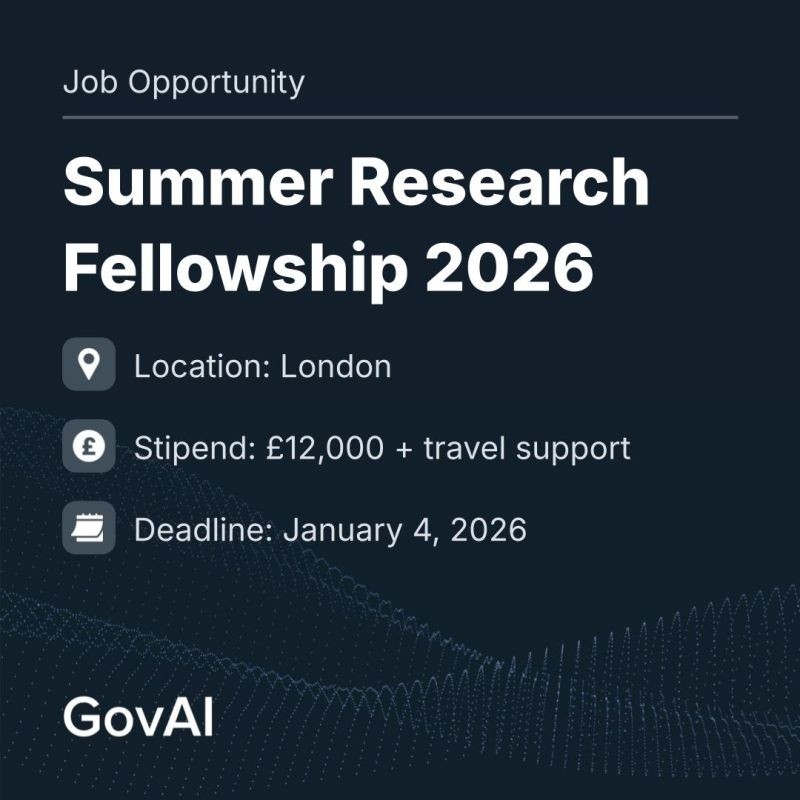
The GovAI Fellowship is an intensive research and professional development programme organized by the Governance of AI (GovAI), a research organization dedicated to improving how advanced artificial intelligence is governed for the benefit of society.
Unlike many traditional academic fellowships, this programme combines:
- Independent research
- Mentorship from experienced AI governance researchers
- Policy discussions
- Collaborative workshops
- Practical learning
- Networking with global experts
Participants work on pressing issues surrounding artificial intelligence while gaining experience that is highly valued by governments, think tanks, universities, international organizations, and technology companies.
Rather than focusing solely on technical AI development, the fellowship explores questions such as:
- How should governments regulate increasingly powerful AI systems?
- What risks could advanced AI pose to society?
- Which international policies encourage responsible AI development?
- How can innovation be balanced with public safety?
- What governance models are most effective across different countries?
These questions are becoming increasingly important as AI adoption accelerates worldwide.
Why the UK Winter Fellowship by GovAI 2027 Fully Funded Is Receiving Global Attention
The UK Winter Fellowship has attracted growing international interest because it offers something many fellowships cannot: meaningful work on one of the world’s fastest-growing policy areas.
Several factors explain why thousands of applicants monitor each application cycle.
It Focuses on One of the World’s Fastest Growing Career Fields
Artificial intelligence governance has evolved into a rapidly expanding profession.
Governments around the world are creating:
- AI regulatory agencies
- Digital policy teams
- AI safety institutes
- Ethical AI advisory boards
- International AI partnerships
As a result, professionals with specialized AI governance knowledge are increasingly valuable.
Completing a respected AI Governance Fellowship can significantly strengthen your professional profile.
It Is Fully Funded
One of the biggest attractions is that the programme removes many financial barriers.
While funding arrangements may vary between fellowship cohorts, successful applicants are generally supported with benefits that can include:
- Accommodation assistance
- Travel support
- Fellowship stipend
- Research resources
- Office facilities
- Professional networking events
- Mentorship opportunities
This financial support allows fellows to concentrate on research rather than worrying about living expenses.
Participants Learn From World-Class Researchers
Another distinguishing feature is direct access to experienced researchers working at the forefront of AI governance.
Instead of relying only on classroom lectures, fellows engage in:
- Small group discussions
- Research feedback sessions
- Writing workshops
- Policy debates
- Collaborative projects
- Guest lectures from international experts
This interactive learning environment accelerates professional development far beyond what many online courses can offer.
International Recognition
The reputation of the GovAI Fellowship continues to grow within:
- Public policy
- Artificial intelligence research
- Academic institutions
- Government agencies
- International organizations
- Technology policy communities
Being selected demonstrates both academic potential and commitment to responsible AI governance.
Governance of AI (GovAI) – Official Opportunities Page
https://www.governance.ai/opportunities
UK Winter Fellowship by GovAI 2027 Eligibility and Benefits
Before investing time in your application, it is important to understand what makes a competitive candidate.
Although eligibility requirements may vary slightly each year, successful applicants generally demonstrate intellectual curiosity, analytical ability, and a genuine interest in AI governance.
Typical Eligibility Requirements
Applicants are often expected to have:
- Strong academic performance
- Excellent written communication skills
- Critical thinking ability
- Interest in public policy or AI
- Research experience (preferred but not always mandatory)
- Ability to collaborate with multidisciplinary teams
- Strong English communication skills
The fellowship welcomes applicants from diverse educational backgrounds.
Many successful fellows come from disciplines such as:
- Computer Science
- Economics
- Political Science
- Law
- Philosophy
- Mathematics
- Public Policy
- International Relations
- Engineering
- Statistics
- Social Sciences
A technical AI background is beneficial but not always required.
Benefits of the GovAI Fellowship
The value of this fellowship extends far beyond funding.
Successful participants gain long-term professional advantages that continue well after the programme concludes.
Professional Benefits
- Work alongside internationally recognized researchers
- Build a strong professional portfolio
- Receive structured mentorship
- Improve policy writing skills
- Learn evidence-based research methods
Career Benefits
Many fellows continue into careers within:
- Government agencies
- International organizations
- Universities
- Research institutes
- AI safety organizations
- Public policy think tanks
- Technology companies
The fellowship also strengthens applications for postgraduate studies and future research opportunities.
Personal Development
Participants often report significant improvements in:
- Analytical thinking
- Communication
- Leadership
- Public speaking
- Collaboration
- Independent research
These transferable skills remain valuable regardless of career path.
GovAI Fellowship at a Glance
| Feature | Details |
|---|---|
| Fellowship Name | GovAI Winter Fellowship |
| Location | United Kingdom |
| Funding | Fully Funded (subject to fellowship terms) |
| Programme Focus | AI Governance, Policy Research, AI Safety |
| Eligible Applicants | International candidates from diverse academic backgrounds |
| Duration | Winter programme (varies by cohort) |
| Main Benefits | Funding, mentorship, networking, research experience |
| Career Outcomes | Research, government, AI policy, academia, think tanks |
Why Competition Is Increasing Every Year
Interest in the Fully Funded UK Fellowship has grown steadily because AI governance has become one of the most influential fields in technology and public policy.
Several trends explain this increase:
- Governments are investing heavily in AI regulation.
- Universities are expanding AI governance research.
- Employers increasingly value policy expertise alongside technical skills.
- International organizations need specialists who understand emerging AI risks.
- AI safety has become a global policy priority.
As awareness of these opportunities grows, competition is expected to become even stronger for the UK Winter Fellowship by GovAI 2027 Fully Funded.
That means applicants who prepare early, understand the programme’s objectives, and submit a thoughtful application will be in a much stronger position than those who rush the process at the last minute.

Understand What the GovAI Fellowship Selection Committee Is Really Looking For
Winning a place in the GovAI Fellowship is about far more than having impressive grades or an eye-catching résumé. Every application cycle attracts talented candidates from across the world, many of whom have excellent academic records and professional achievements. What separates successful applicants is their ability to demonstrate genuine curiosity, sound reasoning, and a strong commitment to improving AI governance.
The fellowship is designed to identify people who can contribute meaningfully to discussions about the future of artificial intelligence. That means the selection committee is interested in your thinking process just as much as your accomplishments.
When reviewing applications, evaluators often look for evidence that you can:
- Analyze complex problems objectively.
- Communicate ideas clearly in writing.
- Learn quickly and adapt to new concepts.
- Conduct independent research.
- Work effectively with people from different disciplines.
- Show intellectual honesty when evaluating evidence.
- Demonstrate genuine motivation for entering the AI governance field.
Instead of asking yourself, “What achievements should I list?”, consider asking:
- Why am I passionate about AI governance?
- What unique perspective can I contribute?
- How have my experiences prepared me for policy research?
- What long-term impact do I hope to make?
Applicants who answer these questions authentically often leave a stronger impression than those who simply list awards and certificates.
Governance of AI (GovAI) – Official Website
https://www.governance.ai
Step 1: Build a Strong Foundation Before Applying for the GovAI Fellowship
One of the biggest mistakes applicants make is preparing only after applications open.
Competitive candidates often spend months developing the knowledge and experience that strengthen their applications.
Fortunately, you don’t need years of professional experience to become competitive. What matters is demonstrating that you’ve taken meaningful steps to understand AI governance.
Develop a Solid Understanding of AI Governance
Since this is an AI Governance Fellowship, reviewers expect applicants to understand the field beyond popular headlines.
Begin exploring topics such as:
- AI safety
- Responsible AI development
- AI ethics
- International AI regulation
- Algorithmic accountability
- Emerging technology policy
- Frontier AI risks
- AI and national security
- Economic impacts of artificial intelligence
Don’t worry about becoming an expert overnight.
Instead, aim to understand:
- Why these issues matter.
- What current debates exist.
- Which organizations are shaping policy.
- Where your own interests lie.
The stronger your understanding, the easier it becomes to write convincing application essays.
Read Research Instead of Only News Articles
News websites provide useful updates, but fellowship reviewers appreciate applicants who engage with original research.
Reading research papers helps you:
- Develop analytical thinking.
- Understand policy debates.
- Improve academic writing.
- Build stronger arguments.
Even reading one or two papers each week over several months can significantly improve your knowledge.
Stay Curious
The strongest applicants rarely pretend to know everything.
Instead, they demonstrate curiosity.
Ask questions like:
- Why are governments approaching AI regulation differently?
- What risks concern policymakers most?
- Which governance frameworks appear most effective?
- What challenges remain unresolved?
Curiosity often matters more than memorizing facts.
Step 2: Align Your Background With the Goals of the UK Winter Fellowship
Many applicants mistakenly believe they must come from computer science.
That simply isn’t true.
The UK Winter Fellowship welcomes applicants from many academic and professional backgrounds.
Examples include:
- Law
- Economics
- Philosophy
- Political Science
- Engineering
- Computer Science
- Statistics
- Public Policy
- Sociology
- Mathematics
- International Relations
Rather than trying to fit into a single profile, explain how your background contributes to AI governance.
For example:
Computer Science Applicants
Highlight experience with:
- Machine learning
- Artificial intelligence
- Data analysis
- AI system development
Then explain why responsible governance matters alongside technological innovation.
Law Students
Discuss experience involving:
- Technology regulation
- Human rights
- Privacy law
- International law
- Public policy
These perspectives are increasingly valuable as governments develop AI legislation.
Economics Students
Economic analysis plays a growing role in AI governance.
Topics may include:
- Labor market changes
- Economic productivity
- Innovation policy
- Competition law
- Market regulation
Demonstrating this connection can strengthen your application considerably.
Social Science Applicants
If your background is in sociology, psychology, philosophy, or political science, emphasize your ability to understand how AI affects people and institutions.
The fellowship values interdisciplinary thinking.
Step 3: Develop High-Quality Research Experience
Research experience doesn’t necessarily mean publishing academic papers.
Instead, reviewers appreciate applicants who can investigate questions carefully and communicate evidence clearly.
Examples include:
- University dissertations
- Independent research projects
- Policy papers
- Literature reviews
- Academic competitions
- Research assistant positions
- Think tank internships
Even personal research projects can demonstrate initiative when presented professionally.
Quality Matters More Than Quantity
Applicants sometimes overwhelm reviewers with long lists of activities.
Instead, focus on explaining:
- What problem you explored.
- Why it mattered.
- How you approached it.
- What conclusions you reached.
- What skills you developed.
Specific examples are much more persuasive than broad claims.
Step 4: Write an Outstanding Personal Statement
Your personal statement is often the most influential part of your application.
This is where the selection committee learns who you are beyond grades and certificates.
A compelling statement should tell a coherent story.
Rather than listing achievements, explain your journey.
Consider structuring your statement around these questions:
Why Are You Interested in AI Governance?
Avoid generic answers like:
“AI is the future.”
Instead, explain:
- What sparked your interest?
- Which experiences influenced your thinking?
- Why does this field matter to you personally?
Specific experiences make your story memorable.
Why the GovAI Fellowship?
Show that you’ve researched the programme.
Explain why its research environment, mentorship, and collaborative approach align with your career goals.
Avoid copying information directly from the programme website.
Instead, connect the fellowship’s objectives with your own aspirations.
What Can You Contribute?
Remember that fellowships are not only about what you gain.
They are also about what you bring.
Discuss:
- Your academic strengths.
- Research experience.
- Professional insights.
- Leadership experiences.
- Cross-cultural perspectives.
- Problem-solving abilities.
Demonstrating both humility and confidence creates a balanced application.
Avoid Common Personal Statement Mistakes
Many applications fail because candidates make avoidable errors.
Some of the most common include:
- Writing overly generic essays.
- Repeating information already found in the CV.
- Using clichés without personal examples.
- Focusing only on achievements instead of motivation.
- Ignoring proofreading.
- Writing excessively long paragraphs.
- Failing to explain career goals.
A clear, engaging, and authentic personal statement will always stand out more than one filled with buzzwords.
Expert Tip: Think Like a Researcher, Not Just an Applicant
One quality that consistently distinguishes successful candidates is their mindset.
Instead of trying to impress the selection committee with exaggerated claims, approach your application the way a researcher approaches a new problem—with curiosity, evidence, and thoughtful reflection.
Show that you’re eager to learn, open to feedback, and capable of contributing to meaningful discussions about the future of AI governance. That combination is often more compelling than a flawless academic record alone.
Step 5: Build a Professional Profile That Strengthens Your GovAI Fellowship Application
A strong application is supported by more than an excellent personal statement. The selection committee will also evaluate the overall picture you present as an applicant. Your academic record, extracurricular involvement, research interests, and professional experiences should work together to demonstrate that you are genuinely interested in AI governance.
Remember, you do not need to have years of experience working in artificial intelligence. What matters most is showing that you have consistently pursued opportunities that align with your interests.
Build Relevant Experience
If you still have time before applications open, consider participating in activities that strengthen your profile, such as:
- Attending AI governance webinars and conferences.
- Completing online courses in artificial intelligence, ethics, or public policy.
- Volunteering with organizations involved in technology or digital policy.
- Joining university research groups or debate societies.
- Writing articles or blog posts on AI policy and governance.
- Participating in policy competitions or hackathons.
Each experience adds another layer to your application and shows that your interest extends beyond simply applying for a fellowship.
Demonstrate Leadership
Leadership does not always mean holding a formal title. The fellowship values applicants who take initiative and contribute positively to their communities.
Examples of leadership include:
- Organizing workshops or seminars.
- Leading student organizations.
- Coordinating volunteer projects.
- Mentoring younger students.
- Launching community technology initiatives.
These experiences illustrate your ability to collaborate, solve problems, and inspire others.
Develop a Professional Online Presence
Many professionals in AI governance actively share research and insights online. While reviewers may not necessarily search for your profile, maintaining a professional digital presence can reinforce your credibility.
Consider:
- Updating your LinkedIn profile.
- Sharing thoughtful discussions about AI governance.
- Publishing articles on Medium or a personal blog.
- Highlighting research projects and academic achievements.
A polished online profile reflects professionalism and genuine engagement with the field.
Step 6: Prepare Outstanding Supporting Documents for the UK Winter Fellowship
Many excellent applicants lose valuable points because they overlook the quality of their supporting documents.
Every document you submit should reinforce the same message: you are prepared, motivated, and capable of contributing to the fellowship.
Curriculum Vitae (CV)
Your CV should be concise, organized, and tailored specifically to the GovAI Fellowship.
Include sections such as:
- Personal information.
- Education.
- Research experience.
- Professional experience.
- Leadership activities.
- Publications (if applicable).
- Conferences attended.
- Awards and scholarships.
- Technical skills.
- Languages.
Avoid adding unrelated experiences that do not strengthen your application.
Instead, focus on quality over quantity.
Academic Transcripts
Your academic transcript provides evidence of your educational performance.
Although excellent grades can strengthen an application, they are only one component of the overall evaluation.
If your transcript contains weaker semesters, you can compensate by demonstrating growth through research, leadership, or professional experience.
Letters of Recommendation
Recommendation letters are most effective when written by people who genuinely know your abilities.
Ideal referees include:
- University professors.
- Research supervisors.
- Academic advisors.
- Employers.
- Project mentors.
A detailed recommendation describing your analytical skills, research ability, and work ethic is much more valuable than a generic letter from a well-known individual.
Provide your referees with sufficient time to prepare thoughtful recommendations.
Writing Samples
Some fellowship programmes request writing samples to evaluate your ability to communicate complex ideas.
Choose work that demonstrates:
- Clear reasoning.
- Strong evidence.
- Logical organization.
- Original analysis.
- High-quality writing.
Always proofread carefully before submission.
Step 7: Understand the GovAI Winter Fellowship 2027 Application Tips and Selection Process
Understanding how applications are evaluated allows you to prepare more strategically.
Although each application cycle may differ slightly, the GovAI Winter Fellowship 2027 Application Tips and Selection Process generally involves multiple stages.
Stage 1: Application Review
The admissions team reviews each application to determine whether candidates meet the fellowship’s academic and professional expectations.
Reviewers assess:
- Academic preparation.
- Motivation.
- Research interests.
- Writing quality.
- Alignment with the fellowship’s objectives.
Applications that clearly demonstrate thoughtful preparation typically move to the next stage.
Stage 2: Shortlisting
At this stage, evaluators compare applicants more closely.
Selection often depends on factors such as:
- Originality of ideas.
- Intellectual curiosity.
- Research potential.
- Communication skills.
- Overall fit with the programme.
Competition becomes increasingly selective during this phase.
Stage 3: Interviews (If Required)
Some fellowship programmes conduct interviews to learn more about shortlisted candidates.
An interview allows reviewers to evaluate:
- Communication ability.
- Critical thinking.
- Motivation.
- Professional maturity.
- Ability to discuss AI governance topics thoughtfully.
Interview questions often focus less on memorized facts and more on how you think through complex issues.
Examples include:
- Why does AI governance matter?
- Which AI risks concern you most?
- What policy challenges should governments prioritize?
- How would you balance innovation with regulation?
- Why do you want to join this fellowship?
Practice answering these questions naturally rather than memorizing scripts.
Stage 4: Final Selection
After evaluating applications, references, and interviews, successful candidates receive fellowship offers.
Selected fellows typically receive detailed information regarding:
- Programme schedule.
- Travel arrangements.
- Funding details.
- Accommodation.
- Orientation activities.
Receiving an offer represents the beginning of an exciting learning journey rather than the end of the application process.
Step 8: Submit a Polished and Error-Free Application
The final step may appear simple, but it can determine whether an otherwise strong application succeeds.
Before submitting your application, review every component carefully.
Complete an Application Checklist
Ensure you have included:
- Completed application form.
- Updated CV.
- Personal statement.
- Academic transcripts.
- Recommendation letters.
- Writing sample (if required).
- Supporting certificates.
- Identification documents.
Submitting incomplete applications can lead to automatic disqualification.
Proofread Everything
Small mistakes can create an impression of carelessness.
Review:
- Grammar.
- Spelling.
- Formatting.
- Dates.
- File names.
- Contact information.
Reading your documents aloud often helps identify awkward sentences and overlooked errors.
Submit Before the Deadline
Avoid waiting until the final hours before submission.
Unexpected issues such as internet problems or technical errors can occur.
Submitting early demonstrates professionalism and provides peace of mind.
Common Mistakes That Reduce Your Chances of Winning the GovAI Fellowship
Even highly qualified applicants sometimes weaken their applications by making avoidable mistakes.
Some of the most common include:
- Applying without thoroughly researching the fellowship.
- Using the same personal statement for multiple programmes.
- Focusing only on academic achievements while ignoring motivation.
- Writing vague or generic responses.
- Failing to explain long-term career goals.
- Ignoring formatting guidelines.
- Waiting until the deadline to prepare application materials.
- Submitting documents without proofreading.
- Choosing referees who cannot provide detailed recommendations.
- Underestimating the importance of clear and concise writing.
Avoiding these pitfalls can significantly improve your competitiveness.
Expert Advice for First-Time Applicants
If this is your first time applying for a competitive international fellowship, remember that rejection does not necessarily reflect your potential.
Many successful fellows applied more than once before receiving an offer.
Each application cycle provides an opportunity to:
- Refine your research interests.
- Improve your writing.
- Gain additional experience.
- Expand your professional network.
- Strengthen your confidence.
Treat the application process itself as an opportunity for growth. Even if you are not selected on your first attempt, the skills you develop—research, critical thinking, and clear communication—will benefit your academic and professional journey for years to come.
How to Apply for UK Winter Fellowship by GovAI 2027: A Step-by-Step Guide
If you have decided that the GovAI Fellowship aligns with your academic and professional aspirations, the next step is preparing and submitting a strong application. While every application cycle may include minor updates, the overall process remains straightforward for candidates who begin early and stay organized.
Rather than rushing through the application a few days before the deadline, give yourself several weeks—or even months—to prepare. This allows enough time to refine your documents, request recommendation letters, and carefully review every requirement.
Step 1: Review the Official Fellowship Information
Before completing any forms, carefully read the official fellowship announcement.
Pay close attention to:
- Eligibility requirements
- Programme duration
- Funding details
- Application timeline
- Required documents
- Selection criteria
- Application instructions
Understanding these details early helps you avoid unnecessary mistakes and ensures your application is tailored to the programme’s expectations.
Step 2: Prepare All Required Documents
Gather your documents before starting the online application. Having everything ready makes the submission process much smoother.
Typical documents include:
- An updated Curriculum Vitae (CV)
- Academic transcripts
- Personal statement or statement of purpose
- Writing sample (if requested)
- Letters of recommendation
- Valid identification or passport
- Any additional supporting documents listed in the application guidelines
Create digital copies in the required file format and ensure each document is clearly named.
Step 3: Complete the Online Application Form
Fill out every section of the application accurately.
Avoid rushing through the form. Instead:
- Double-check dates and academic qualifications.
- Use consistent formatting.
- Ensure your contact details are correct.
- Answer every required question thoughtfully.
- Save your progress regularly if the platform allows.
Small administrative errors can create unnecessary complications later in the review process.
Step 4: Tailor Your Personal Statement
Your personal statement should explain:
- Why you are interested in AI governance.
- Why the UK Winter Fellowship by GovAI 2027 Fully Funded programme is the right fit for your goals.
- What experiences have prepared you for the fellowship.
- How you intend to contribute to discussions and research.
- Your long-term academic or professional ambitions.
Avoid copying content from previous scholarship applications. A personalized statement demonstrates genuine interest and effort.
Step 5: Submit Before the Deadline
Once you have reviewed every section of your application, submit it well before the closing date.
Early submission gives you time to address any unexpected technical issues and demonstrates good planning.
After submission:
- Save your confirmation email.
- Keep copies of all submitted documents.
- Monitor your inbox for updates or additional requests from the fellowship team.
Application Checklist
Use this checklist before clicking the submit button.
| Requirement | Status |
|---|---|
| Read the official fellowship guidelines | |
| Confirm eligibility | |
| Updated CV prepared | |
| Personal statement completed | |
| Academic transcripts uploaded | |
| Recommendation letters submitted | |
| Writing sample attached (if required) | |
| Contact information verified | |
| Documents proofread | |
| Application submitted before deadline |
Frequently Asked Questions (FAQs)
1. What is the GovAI Fellowship?
The GovAI Fellowship is a research-focused programme organized by Governance of AI (GovAI). It brings together talented individuals interested in artificial intelligence governance, public policy, and AI safety to conduct research, collaborate with experts, and contribute to important policy discussions.
2. Is the UK Winter Fellowship by GovAI 2027 fully funded?
The fellowship is generally designed to reduce financial barriers for successful applicants. Depending on the specific cohort and programme arrangements, funding may include travel support, accommodation assistance, a stipend, and access to research resources. Applicants should always review the official programme information for the latest funding details.
3. Who can apply?
The fellowship welcomes applicants from diverse academic and professional backgrounds.
Common fields include:
- Computer Science
- Economics
- Law
- Public Policy
- Political Science
- Mathematics
- Philosophy
- Engineering
- Statistics
- International Relations
- Social Sciences
Applicants should demonstrate a strong interest in AI governance, research, and public policy.
4. Do I need previous AI research experience?
Not necessarily.
While research experience is beneficial, applicants from non-technical backgrounds are also encouraged to apply if they can demonstrate analytical ability, intellectual curiosity, and a genuine interest in AI governance.
5. Is English language proficiency required?
Since the fellowship is conducted in English, applicants should be comfortable reading academic materials, participating in discussions, and producing high-quality written work.
Always refer to the official application guidelines for any specific language requirements.
6. How competitive is the GovAI Fellowship?
The fellowship is highly competitive due to its international reputation and fully funded opportunities.
Strong applications typically demonstrate:
- Academic excellence.
- Clear motivation.
- Research potential.
- Excellent communication skills.
- A thoughtful understanding of AI governance.
7. Can international students apply?
Yes. The programme has historically welcomed talented applicants from around the world, subject to the eligibility requirements for each application cycle.
8. What happens after I submit my application?
Applications generally go through several stages, including eligibility checks, detailed review, shortlisting, and, where applicable, interviews before final decisions are announced.
Final Thoughts
The rapid advancement of artificial intelligence has created new opportunities—and new responsibilities—for researchers, policymakers, and professionals around the world. Programmes like the GovAI Fellowship are helping to prepare the next generation of experts who will shape how advanced AI is governed in the years ahead.
The UK Winter Fellowship is much more than a funded research opportunity. It offers participants access to an intellectually stimulating environment where they can collaborate with leading researchers, develop practical policy expertise, and contribute to discussions that may influence the future of AI governance.
If you are genuinely interested in understanding how emerging technologies can be developed responsibly and regulated effectively, investing time in preparing a thoughtful application is well worth the effort.
Start early, build your knowledge gradually, seek meaningful research experiences, and present an authentic story about why this field matters to you. Those steps will not only strengthen your fellowship application but also prepare you for a rewarding career in one of the world’s fastest-evolving disciplines.
Conclusion
The GovAI Fellowship has quickly become one of the most sought-after opportunities for aspiring researchers, policymakers, and professionals who want to shape the future of artificial intelligence. If you are searching for a Fully Funded UK Fellowship that combines world-class mentorship, hands-on research, and meaningful policy engagement, the UK Winter Fellowship by GovAI 2027 Fully Funded programme deserves a place at the top of your list.
Throughout this guide, we’ve explored the UK Winter Fellowship by GovAI 2027 Eligibility and Benefits, discussed the GovAI Winter Fellowship 2027 Application Tips and Selection Process, and provided a practical roadmap explaining How to Apply for UK Winter Fellowship by GovAI 2027 successfully. From understanding the selection criteria to writing a compelling personal statement and preparing strong supporting documents, every step you take can improve your chances of joining this prestigious AI Governance Fellowship.
While competition for the GovAI Fellowship is expected to remain strong, successful applicants are rarely those with the longest résumés alone. Instead, they are individuals who demonstrate intellectual curiosity, strong analytical skills, clear communication, and a genuine commitment to responsible AI governance. By preparing early, building relevant research experience, and tailoring your application to the programme’s objectives, you can position yourself as a competitive candidate for the UK Winter Fellowship.
As artificial intelligence continues to transform governments, businesses, and societies around the world, the demand for experts in AI policy and governance will only continue to grow. Completing the UK Winter Fellowship by GovAI 2027 Fully Funded programme can open doors to careers in government, international organizations, research institutes, universities, think tanks, and leading technology companies.
If your goal is to contribute to the future of AI while learning from some of the world’s leading researchers, don’t wait until applications open. Start preparing now, continue strengthening your knowledge of AI governance, monitor official programme announcements, and refine your application materials well in advance. The GovAI Fellowship is more than a prestigious international opportunity—it is a gateway to becoming part of the next generation of leaders shaping responsible artificial intelligence on a global scale.
Leave a Reply