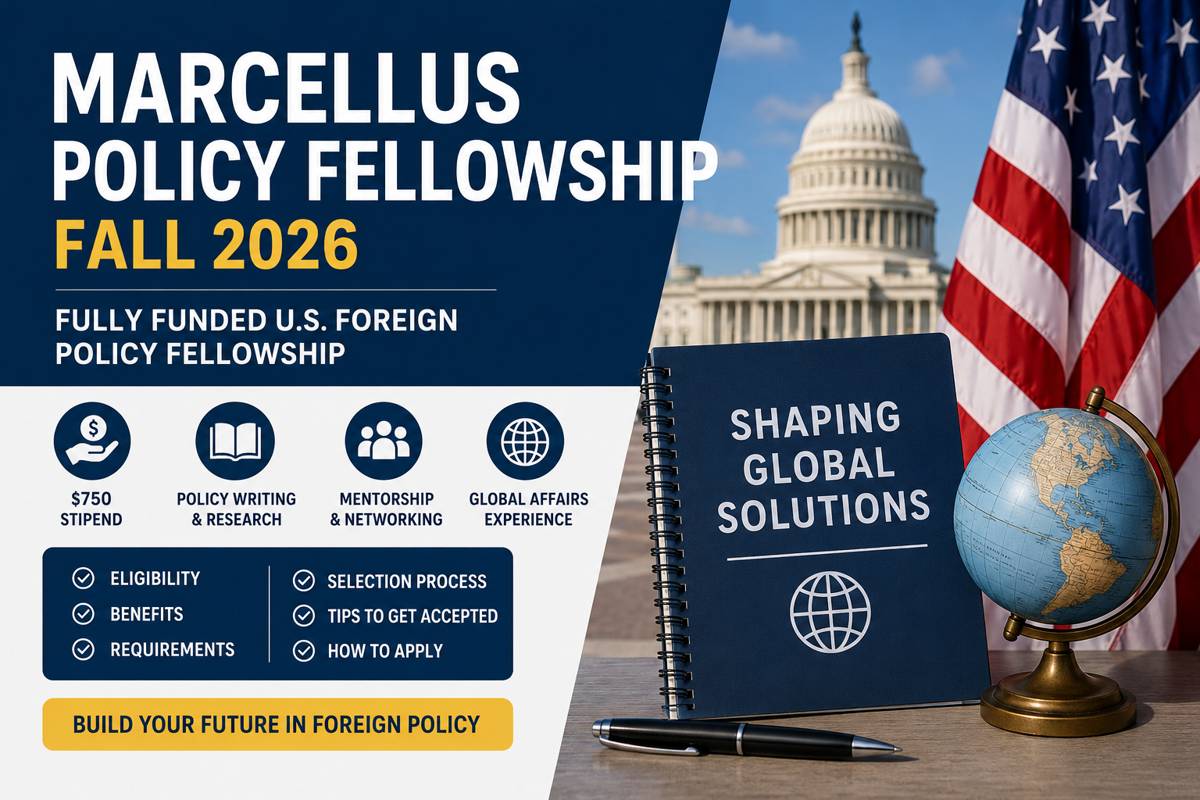
The world needs more thoughtful leaders than ever before. Every major issue—from international security and economic development to climate change, technology, and democracy—depends on people who understand public policy and know how to turn ideas into action.
That is exactly where the Marcellus Policy Fellowship comes in.
If you’ve been searching for a prestigious Policy Fellowship 2026 that helps emerging professionals, students, researchers, journalists, and policy enthusiasts develop practical leadership skills, this fellowship deserves your attention.
Unlike many programs that focus only on classroom instruction, the Marcellus Policy Fellowship combines policy education, mentorship, networking, and hands-on discussions with experienced experts. Participants gain valuable insight into today’s most pressing public policy challenges while building relationships that can shape their future careers.
Whether your goal is to work in government, international affairs, think tanks, nonprofit organizations, journalism, advocacy, or academia, participating in a respected Public Policy Fellowship can significantly strengthen your profile.
In this comprehensive guide, you’ll discover:
- What the Marcellus Policy Fellowship is
- The biggest benefits of joining
- Eligibility requirements
- Application timeline
- Important deadline information
- Required documents
- Selection criteria
- Step-by-step application process
- Expert tips that can improve your chances of selection
Let’s begin by understanding why this fellowship has attracted increasing attention from aspiring policy leaders around the world.

Marcellus Policy Fellowship at a Glance
| Feature | Details |
|---|---|
| Fellowship Name | Marcellus Policy Fellowship |
| Program | Policy Leadership Fellowship |
| Focus Areas | Public Policy, Foreign Policy, Leadership, Economics, Governance |
| Application Cycle | Fall 2026 |
| Eligible Applicants | Students, Graduates, Young Professionals and Policy Enthusiasts (subject to official criteria) |
| Program Benefits | Policy education, networking, mentorship, professional development |
| Application Mode | Online |
| Official Website | |
| Application Status | Refer to the official announcement for current dates and updates. |
What Is the Marcellus Policy Fellowship?
The Marcellus Policy Fellowship is a competitive leadership and policy education program designed to prepare emerging leaders for careers that influence public decision-making.
Rather than focusing solely on academic theory, the fellowship introduces participants to practical policy discussions through expert-led sessions, collaborative learning, and exposure to real-world governance issues.
Participants explore topics including:
- Foreign policy
- National security
- Economic policy
- Constitutional principles
- Public administration
- Leadership development
- Political philosophy
- International affairs
- Public communication
- Civic engagement
The fellowship encourages critical thinking instead of simply presenting one perspective. Fellows are expected to analyze complex policy challenges, evaluate different viewpoints, and develop evidence-based solutions.
This approach makes the program attractive to individuals interested in becoming future policymakers, researchers, analysts, educators, journalists, and nonprofit leaders.
Why the Marcellus Policy Fellowship Is Becoming Increasingly Popular
Competition for high-quality fellowships has intensified over the past few years.
Students and professionals are no longer looking only for financial support. They also want opportunities that provide:
- Practical experience
- Professional credibility
- Global networking
- Career mentorship
- Leadership development
- Exposure to influential experts
The Marcellus Policy Fellowship Fall 2026 addresses these expectations by offering an environment where participants engage deeply with contemporary policy issues while building relationships that extend beyond the fellowship itself.
Unlike many short workshops, participants leave with stronger analytical skills, broader professional networks, and increased confidence discussing policy issues.
These long-term benefits explain why interest in the fellowship continues to grow.
Who Should Apply for the Marcellus Policy Fellowship?
One misconception is that only political science graduates should consider applying.
In reality, modern policy problems require experts from many disciplines.
The fellowship may be valuable for individuals interested in:
- Political Science
- Economics
- Law
- International Relations
- Journalism
- Public Administration
- Sociology
- Education
- Business
- Technology Policy
- Security Studies
- Environmental Policy
- Healthcare Policy
- Public Affairs
Even professionals working outside government can benefit because public policy influences nearly every sector of society.
Marcellus Policy Fellowship: 10 Powerful Benefits
Joining a competitive Foreign Policy Fellowship is about much more than adding another certificate to your résumé.
The real value lies in the knowledge, relationships, and experiences you gain throughout the program.
Let’s examine the most significant benefits.
1. Marcellus Policy Fellowship Builds Exceptional Leadership Skills
Leadership is not simply about managing people.
Great leaders understand how policies affect communities, businesses, governments, and international relationships.
One of the strongest advantages of the Marcellus Policy Fellowship is its emphasis on leadership development.
Participants learn how to:
- Think strategically
- Evaluate policy alternatives
- Solve complex problems
- Communicate effectively
- Lead productive discussions
- Analyze evidence objectively
- Build consensus
These abilities remain valuable throughout an entire career, regardless of industry.
2. Marcellus Policy Fellowship Expands Your Professional Network
Networking is one of the most underestimated career investments.
Many successful professionals secure internships, research opportunities, collaborations, and employment through relationships developed during fellowship programs.
The fellowship allows participants to connect with:
- Policy experts
- Researchers
- Government professionals
- Academics
- Journalists
- Think tank leaders
- Alumni
- Fellow participants
These connections often continue long after the program concludes.
Over time, they may become sources of mentorship, collaboration, and career opportunities.
3. Marcellus Policy Fellowship Strengthens Your Career Profile
Recruiters increasingly value practical learning experiences.
Completing a respected Public Policy Fellowship demonstrates qualities employers appreciate, including:
- Commitment to continuous learning
- Intellectual curiosity
- Leadership potential
- Communication skills
- Policy literacy
- Team collaboration
- Critical thinking
Whether you’re applying for graduate school, internships, scholarships, research positions, or full-time employment, fellowship experience can help distinguish your application from other candidates.
It also signals that you have invested time in developing expertise beyond traditional classroom education.
4. Marcellus Policy Fellowship Provides Real Policy Exposure
Reading textbooks and academic articles provides important theoretical knowledge.
However, understanding how policy decisions are actually developed requires exposure to experienced practitioners.
One major advantage of the Marcellus Policy Fellowship Fall 2026 is the opportunity to engage with discussions that connect theory to practice.
Participants gain insight into how governments, institutions, and policy organizations analyze complex issues, balance competing priorities, and develop practical solutions.
Instead of viewing policy as an abstract concept, fellows begin to appreciate the real-world challenges involved in decision-making, implementation, and public communication.
This practical perspective can be invaluable for anyone considering a future in public service, international affairs, research, advocacy, or policy analysis.
5. Marcellus Policy Fellowship Enhances Your Critical Thinking and Policy Analysis Skills
One quality that distinguishes outstanding policy professionals is their ability to think critically rather than emotionally.
The Marcellus Policy Fellowship encourages participants to examine complex public issues from multiple perspectives. Instead of accepting simple answers, fellows are challenged to ask thoughtful questions, analyze evidence, compare competing policy proposals, and understand the broader implications of government decisions.
During the fellowship, participants often strengthen their ability to:
- Evaluate policy proposals objectively
- Interpret research and data effectively
- Identify strengths and weaknesses in public policies
- Develop practical recommendations
- Consider the long-term consequences of policy decisions
- Communicate evidence-based arguments clearly
These skills are valuable not only in government and public service but also in consulting, journalism, business strategy, nonprofit leadership, and academic research.
6. Marcellus Policy Fellowship Offers Valuable Mentorship Opportunities
A successful career rarely develops without guidance from experienced professionals.
One of the greatest advantages of the Marcellus Policy Fellowship Fall 2026 is the opportunity to learn directly from individuals who have spent years working in policy, governance, economics, leadership, and public affairs.
Mentorship can help fellows:
- Make informed career decisions
- Identify areas for professional growth
- Build confidence in leadership roles
- Receive constructive feedback
- Understand industry expectations
- Expand professional networks
For many fellows, these mentor relationships continue long after the fellowship concludes, creating lasting professional connections that support future career development.
7. Marcellus Policy Fellowship Improves Research and Communication Skills
Policy professionals are expected to communicate complex ideas in a way that diverse audiences can understand.
Throughout the fellowship, participants strengthen essential communication skills, including:
- Policy writing
- Public speaking
- Professional presentations
- Research interpretation
- Report writing
- Analytical discussions
- Persuasive communication
Developing these abilities helps participants become more effective leaders regardless of their future career path.
Strong communication is especially important for those pursuing careers in:
- Government agencies
- International organizations
- Think tanks
- Universities
- Research institutions
- Media organizations
- Civil society organizations
8. Marcellus Policy Fellowship Encourages Interdisciplinary Learning
Modern policy challenges rarely fit into one academic discipline.
Issues such as climate change, cybersecurity, healthcare, economic development, artificial intelligence, immigration, and international security require expertise from multiple fields.
The Marcellus Policy Fellowship introduces participants to discussions that cross disciplinary boundaries, encouraging collaboration among individuals with diverse educational and professional backgrounds.
This interdisciplinary approach helps fellows understand how economics, law, technology, politics, business, and public administration interact when shaping effective policies.
Such broad exposure prepares participants to tackle increasingly complex global challenges.
9. Marcellus Policy Fellowship Builds Long-Term Professional Credibility
Participating in a competitive Policy Fellowship 2026 demonstrates initiative and commitment to professional development.
Employers, graduate schools, research institutions, and scholarship committees often value applicants who actively pursue opportunities outside traditional education.
Completing the fellowship can strengthen your professional profile by demonstrating:
- Leadership potential
- Intellectual curiosity
- Commitment to public service
- Analytical ability
- Continuous learning
- Professional discipline
While no fellowship guarantees employment, participating in respected leadership programs can significantly enhance your credibility when pursuing future opportunities.
10. Marcellus Policy Fellowship Opens Doors to Future Opportunities
Perhaps the greatest benefit of the Marcellus Policy Fellowship is not what happens during the program—it is what happens afterward.
Former fellows often use the experience as a stepping stone toward:
- Graduate studies
- Research fellowships
- Policy internships
- Think tank positions
- Government employment
- International development careers
- Academic research
- Leadership positions within nonprofit organizations
The knowledge, confidence, and professional relationships developed during the fellowship frequently continue creating opportunities years after completion.
For many participants, the fellowship becomes an important milestone in their leadership journey.
Summary of the 10 Powerful Benefits
| Benefit | Why It Matters |
|---|---|
| Leadership Development | Builds confidence and strategic decision-making skills |
| Professional Networking | Connects fellows with experts and future collaborators |
| Stronger Career Profile | Enhances resumes, graduate school applications, and job prospects |
| Real Policy Exposure | Bridges theory with real-world governance |
| Critical Thinking | Strengthens analytical and problem-solving abilities |
| Mentorship | Provides valuable career guidance from experienced professionals |
| Communication Skills | Improves writing, speaking, and policy presentation |
| Interdisciplinary Learning | Broadens understanding across multiple policy fields |
| Professional Credibility | Demonstrates commitment to leadership and lifelong learning |
| Future Opportunities | Creates pathways to careers, research, and further education |
Marcellus Policy Fellowship Fall 2026 Eligibility
Understanding the Marcellus Policy Fellowship 2026 eligibility and application process is one of the most important steps before preparing your application.
Eligibility requirements may vary slightly between fellowship cycles, so applicants should always verify the latest information on the official program website before applying.
Generally, strong candidates demonstrate a genuine interest in public policy, leadership, governance, economics, or related fields.
Applicants are often expected to possess:
- Strong academic or professional potential
- Excellent communication skills
- Interest in public policy discussions
- Leadership experience or leadership potential
- Commitment to civic engagement
- Willingness to participate actively in fellowship activities
The fellowship seeks individuals who are eager to contribute meaningfully to policy conversations while learning from experienced professionals.
Who Can Apply for the Marcellus Policy Fellowship?
The fellowship may be suitable for applicants such as:
- Undergraduate students
- Graduate students
- Recent graduates
- Young professionals
- Researchers
- Journalists
- Policy analysts
- Public servants
- Nonprofit professionals
- Educators
- Entrepreneurs interested in policy
- Civic leaders
Applicants from a wide range of academic disciplines are often encouraged to apply, particularly those whose work intersects with public policy.
Academic Backgrounds That Fit the Fellowship
Although applicants from various disciplines may be considered, the following backgrounds often align well with the program:
- Political Science
- Public Administration
- Public Policy
- International Relations
- Law
- Economics
- History
- Journalism
- Sociology
- Philosophy
- Business
- International Development
- Security Studies
- Environmental Studies
However, interdisciplinary applicants with strong leadership potential may also be competitive.
Required Documents for the Marcellus Policy Fellowship Application
While official requirements should always be confirmed during the application period, applicants commonly prepare documents such as:
- Completed online application form
- Updated curriculum vitae (CV) or résumé
- Personal statement or statement of purpose
- Academic transcripts (if required)
- Professional biography
- Writing sample (if requested)
- Letters of recommendation (where applicable)
- Valid identification or passport
- Additional supporting documents requested by the organizers
Preparing these materials early allows applicants sufficient time to review and improve the quality of their submissions.

Marcellus Policy Fellowship Selection Criteria
The fellowship is competitive, meaning selection committees typically evaluate applicants holistically rather than focusing on a single factor.
Common evaluation areas include:
Academic Achievement
Strong academic performance demonstrates the ability to handle rigorous discussions and policy analysis.
Leadership Experience
Applicants who have led projects, organizations, research initiatives, or community activities often present stronger applications.
Commitment to Public Service
Evidence of civic engagement, volunteer work, advocacy, or community involvement may strengthen an application.
Communication Skills
Applicants should demonstrate the ability to communicate ideas clearly through writing and discussion.
Motivation
Selection committees often look for applicants whose personal goals align with the fellowship’s mission of developing future policy leaders.
Professional Potential
Reviewers may also consider how the fellowship will contribute to an applicant’s long-term career development and future impact.
At this stage, you should have a solid understanding of the fellowship’s value and the qualities sought in successful applicants.
By now, you have a clear understanding of the value of the Marcellus Policy Fellowship, its major benefits, and the qualifications that make an applicant competitive. The next step is equally important—understanding exactly how to apply for Marcellus Policy Fellowship Fall 2026 and preparing an application that stands out for the right reasons.
Remember, even highly qualified candidates can miss out on opportunities because they overlook application instructions, submit incomplete documents, or fail to communicate their goals effectively. This section will walk you through the process in a practical and easy-to-follow manner.
Marcellus Policy Fellowship 2026 Eligibility and Application Process
One of the most common questions prospective applicants ask is, “What does the selection committee actually look for?”
The answer goes beyond grades or professional achievements. The fellowship seeks individuals who are genuinely interested in public policy, leadership, and contributing to meaningful conversations that shape society.
Although each application cycle may have slight variations, the Marcellus Policy Fellowship 2026 eligibility and application process generally involves several structured stages.
Typical Application Stages
| Stage | Description |
|---|---|
| Online Application | Complete the official application form accurately. |
| Document Submission | Upload all required supporting documents. |
| Initial Screening | Applications are reviewed for completeness and eligibility. |
| Merit Evaluation | Reviewers assess leadership potential, motivation, and overall fit. |
| Interview (if applicable) | Shortlisted candidates may be invited for an interview. |
| Final Selection | Successful applicants receive official notification. |
Treat every stage seriously. A well-prepared application creates a positive first impression before the selection committee even begins evaluating your qualifications.
How to Apply for Marcellus Policy Fellowship Fall 2026
If you are planning to submit an application, following a systematic approach can significantly improve your chances of success.
Step 1: Review the Official Fellowship Announcement
Begin by carefully reading the official fellowship announcement. This document contains the most reliable information about:
- Eligibility requirements
- Application opening date
- Closing deadline
- Required documents
- Program schedule
- Selection criteria
- Frequently asked questions
Avoid relying solely on third-party sources, as application requirements may change from one fellowship cycle to another.
Step 2: Confirm That You Meet the Eligibility Requirements
Before investing time in your application, confirm that you satisfy all eligibility conditions.
Pay attention to details such as:
- Academic qualifications
- Professional background
- Language requirements (if any)
- Residency or nationality requirements
- Age requirements (if specified)
- Availability during the fellowship period
This simple step can save considerable time and prevent unnecessary disappointment.
Step 3: Prepare Your Application Documents Early
Many applicants wait until the final week before gathering their documents.
This is a common mistake.
Instead, prepare everything well in advance, including:
- Updated CV or résumé
- Statement of purpose
- Academic transcripts
- Identification documents
- Recommendation letters
- Writing samples (if requested)
Early preparation allows time for proofreading and revisions, resulting in a stronger application.
Step 4: Write a Strong Personal Statement
Your personal statement is one of the most influential parts of your application.
Rather than repeating information already included in your CV, use this opportunity to explain:
- Why you are interested in public policy
- What inspired your career goals
- Your leadership experiences
- Community involvement
- Professional aspirations
- How the fellowship aligns with your future plans
The strongest essays are authentic, well-organized, and supported with specific examples.
Avoid exaggeration or generic statements that could apply to anyone.
Step 5: Highlight Your Leadership Experience
Leadership does not always mean holding a formal title.
The selection committee appreciates applicants who have demonstrated initiative in different settings.
Examples include:
- Organizing community projects
- Leading student organizations
- Conducting research
- Coordinating volunteer activities
- Managing workplace initiatives
- Launching social impact projects
Focus on measurable outcomes whenever possible.
For example:
Instead of saying:
“I helped organize a conference.”
Write:
“I coordinated a team of 20 volunteers to organize a regional policy conference attended by over 300 participants.”
Specific achievements are much more persuasive.
Step 6: Review Your Application Carefully
Before clicking “Submit,” review every section carefully.
Check for:
- Grammar mistakes
- Spelling errors
- Missing attachments
- Incorrect dates
- Formatting issues
- Inconsistent information
Even minor errors can affect the professionalism of your application.
Step 7: Submit Before the Deadline
Submitting early provides several advantages.
It allows you to:
- Avoid technical issues
- Correct unexpected errors
- Receive confirmation of submission
- Reduce last-minute stress
Many successful applicants submit several days before the official deadline rather than waiting until the final hours.
Marcellus Policy Fellowship Fall 2026 Deadline
The Marcellus Policy Fellowship Fall 2026 deadline is one of the most important details applicants should monitor.
Application deadlines can vary by fellowship cycle, and organizers may update timelines or extend deadlines when necessary.
For that reason, applicants should regularly check the official fellowship website for the most current information instead of relying on unofficial sources.
To avoid missing important dates:
- Bookmark the official application page.
- Set reminders on your phone or calendar.
- Subscribe to official updates if available.
- Aim to submit your application several days before the closing date.
Planning ahead gives you time to resolve any unexpected technical or document-related issues.
Common Mistakes Applicants Should Avoid
Every year, many qualified applicants weaken their chances by making avoidable mistakes.
Here are some of the most common:
1. Waiting Until the Last Minute
Rushed applications often contain errors and incomplete information.
2. Ignoring Application Instructions
Failure to follow formatting guidelines or document requirements may result in disqualification.
3. Submitting a Generic Personal Statement
Selection committees can easily recognize essays copied from previous applications.
Personalize every application.
4. Providing Incomplete Information
Double-check every section before submission.
Missing information may delay or negatively affect your application.
5. Poor Proofreading
Small grammar mistakes rarely eliminate candidates on their own, but multiple errors can reduce the overall quality of your application.
6. Weak Leadership Examples
Instead of listing activities, explain your specific contributions and measurable impact.
7. Underestimating the Competition
The Marcellus Policy Fellowship attracts highly motivated applicants.
A thoughtful, polished application is essential.
Expert Tips to Increase Your Chances of Selection
Although no strategy guarantees acceptance, the following practices can strengthen your application.
Start Early
Strong applications are rarely written overnight.
Research the Fellowship
Understand the fellowship’s mission, objectives, and areas of focus.
Demonstrate that your goals align with the program.
Demonstrate Genuine Motivation
Avoid writing what you think reviewers want to hear.
Instead, explain your authentic interest in public policy and leadership.
Quantify Your Achievements
Numbers make accomplishments more convincing.
Examples include:
- Number of people impacted
- Budget managed
- Research projects completed
- Events organized
- Volunteers supervised
Ask for Feedback
Before submitting, ask a trusted mentor, professor, or colleague to review your application.
Fresh perspectives often identify weaknesses you may overlook.
Stay Professional
Every component of your application should reflect professionalism, including:
- Email address
- CV formatting
- Writing style
- File names
- Grammar
- Organization
Professional presentation leaves a positive impression.
Application Preparation Checklist
Use this checklist before submitting your application:
| Task | Status |
|---|---|
| Read official guidelines | |
| Confirm eligibility | |
| Prepare updated CV | |
| Write personal statement | |
| Gather supporting documents | |
| Request recommendation letters | |
| Proofread all documents | |
| Review application form | |
| Submit before deadline | |
| Save confirmation email |
Completing each item carefully can help ensure that your application is complete, accurate, and professionally presented.
At this point, you now understand how to apply for Marcellus Policy Fellowship Fall 2026, the typical application process, common pitfalls to avoid, and practical strategies for submitting a stronger application.
You now have a complete understanding of the Marcellus Policy Fellowship, from its benefits and eligibility requirements to the application process and practical tips for preparing a competitive application.
Marcellus Policy Fellowship vs Other Public Policy Fellowship Programs
Choosing the right fellowship can be challenging because many leadership and policy programs offer valuable opportunities. However, each fellowship has a different focus, target audience, and expected outcomes.
The Marcellus Policy Fellowship distinguishes itself by emphasizing practical foreign policy analysis, professional writing, and mentorship while preparing participants for careers in U.S. national security and foreign policy. Fellows produce a policy paper, policy memorandum, and opinion article under expert guidance, and selected fellows receive a $750 stipend. The program typically selects 8–12 fellows for each of its Spring and Fall cohorts.
| Fellowship | Primary Focus | Best For | Distinguishing Feature |
|---|---|---|---|
| Marcellus Policy Fellowship | U.S. Foreign Policy & National Security | Students and early-career professionals | Policy writing, expert mentorship, policy paper, stipend |
| Public Policy Fellowships | Government & Public Administration | Future public administrators | Governance and leadership training |
| Foreign Policy Fellowships | International Affairs | Aspiring diplomats and analysts | International relations and security |
| Leadership Fellowships | Executive Leadership | Professionals across sectors | Management and leadership development |
If your long-term goal is to work in foreign affairs, think tanks, government agencies, academia, or policy research, the Marcellus Policy Fellowship offers a focused pathway to build the skills employers and graduate programs value.
Why the Marcellus Policy Fellowship Is Worth Considering
There are many reasons this fellowship continues to attract highly motivated applicants every year.
Some of the strongest advantages include:
- Exposure to leading foreign policy experts.
- Practical experience writing policy analyses and policy memoranda.
- Individual mentorship throughout the program.
- Opportunities to strengthen professional writing skills.
- A competitive selection process that enhances the fellowship’s reputation.
- Networking with fellow participants interested in public policy.
- A financial stipend for selected fellows.
- Experience that strengthens graduate school and employment applications.
Perhaps most importantly, participants leave the program with a stronger understanding of how policy ideas move from research into real-world decision-making.

Frequently Asked Questions (FAQs)
1. What is the Marcellus Policy Fellowship?
The Marcellus Policy Fellowship is a competitive leadership and professional development program created by the John Quincy Adams Society to prepare emerging foreign policy leaders through policy writing, mentorship, and expert-led discussions.
2. Who can apply for the Marcellus Policy Fellowship?
The fellowship is generally open to:
- Undergraduate students
- Graduate students
- Individuals with 0–2 years of foreign policy employment experience
- Applicants interested in careers involving U.S. foreign policy or national security
U.S. citizenship is not required, making the program accessible to qualified international applicants as well.
3. Is the Marcellus Policy Fellowship fully funded?
The fellowship provides a $750 stipend for selected fellows. Applicants should review the official fellowship information for the most up-to-date details on funding and program benefits.
4. Is work experience required?
Not necessarily.
Current students are eligible, and applicants with up to two years of foreign policy-related employment are also encouraged to apply. Internships generally do not count toward this experience limit.
5. Is the fellowship open to international applicants?
Yes.
According to the official program information, U.S. citizenship is not required.
6. What documents are commonly required?
Applicants should be prepared to submit:
- Online application
- CV or résumé
- Personal statement
- Supporting documents requested during the application process
- Any additional materials specified in the official announcement
Always consult the current application guidelines before submitting.
7. What skills do fellows develop?
Participants strengthen skills in:
- Policy analysis
- Leadership
- Professional writing
- Public communication
- Research
- Critical thinking
- Networking
- Policy advocacy
8. Why is the fellowship competitive?
Only a limited number of fellows are selected for each cohort, and applicants are evaluated based on leadership potential, policy interest, writing ability, and overall fit with the program’s mission.
9. How can I improve my chances of selection?
Applicants should:
- Begin preparing early.
- Tailor their personal statement.
- Demonstrate leadership and initiative.
- Highlight relevant academic or professional achievements.
- Proofread every application document carefully.
- Submit before the deadline.
10. Is the Marcellus Policy Fellowship valuable for graduate school applications?
Yes.
Competitive fellowships demonstrate initiative, leadership, and commitment to professional development. They can strengthen applications for graduate programs, research positions, and careers in public policy and international affairs.
Final Application Checklist
Before submitting your application, confirm that you have completed the following:
- Read the official fellowship announcement.
- Confirmed your eligibility.
- Updated your résumé or CV.
- Written a compelling personal statement.
- Gathered all required documents.
- Reviewed every section for accuracy.
- Proofread your application.
- Submitted before the official deadline.
- Saved your submission confirmation.
Completing this checklist reduces the risk of avoidable mistakes and helps present your application professionally.
Final Thoughts on the Marcellus Policy Fellowship
The Marcellus Policy Fellowship is much more than another line on a résumé. It is an opportunity to develop practical policy skills, receive mentorship from experienced professionals, and engage in meaningful discussions about the future of foreign policy and national security.
Whether you are an undergraduate student exploring career options, a graduate student seeking specialized policy experience, or an early-career professional looking to sharpen your analytical and writing skills, this fellowship provides a valuable platform for growth.
Because the program is highly competitive, preparation is essential. Start early, understand the fellowship’s objectives, invest time in a thoughtful personal statement, and present a polished application that reflects your genuine interest in public policy and leadership.
Even if you are not selected on your first attempt, the process itself can help you clarify your career goals, improve your professional writing, and prepare for future fellowships or graduate opportunities.
If you believe your future lies in shaping policy, influencing public debate, or contributing to better governance, the Marcellus Policy Fellowship Fall 2026 is certainly an opportunity worth pursuing.
For the most accurate and up-to-date application information, visit the official John Quincy Adams Society fellowship page: John Quincy Adams Society – Marcellus Policy Fellowship
To explore additional international affairs and policy fellowship opportunities, visit APSIA Fellowships & Scholarships
Leave a Reply