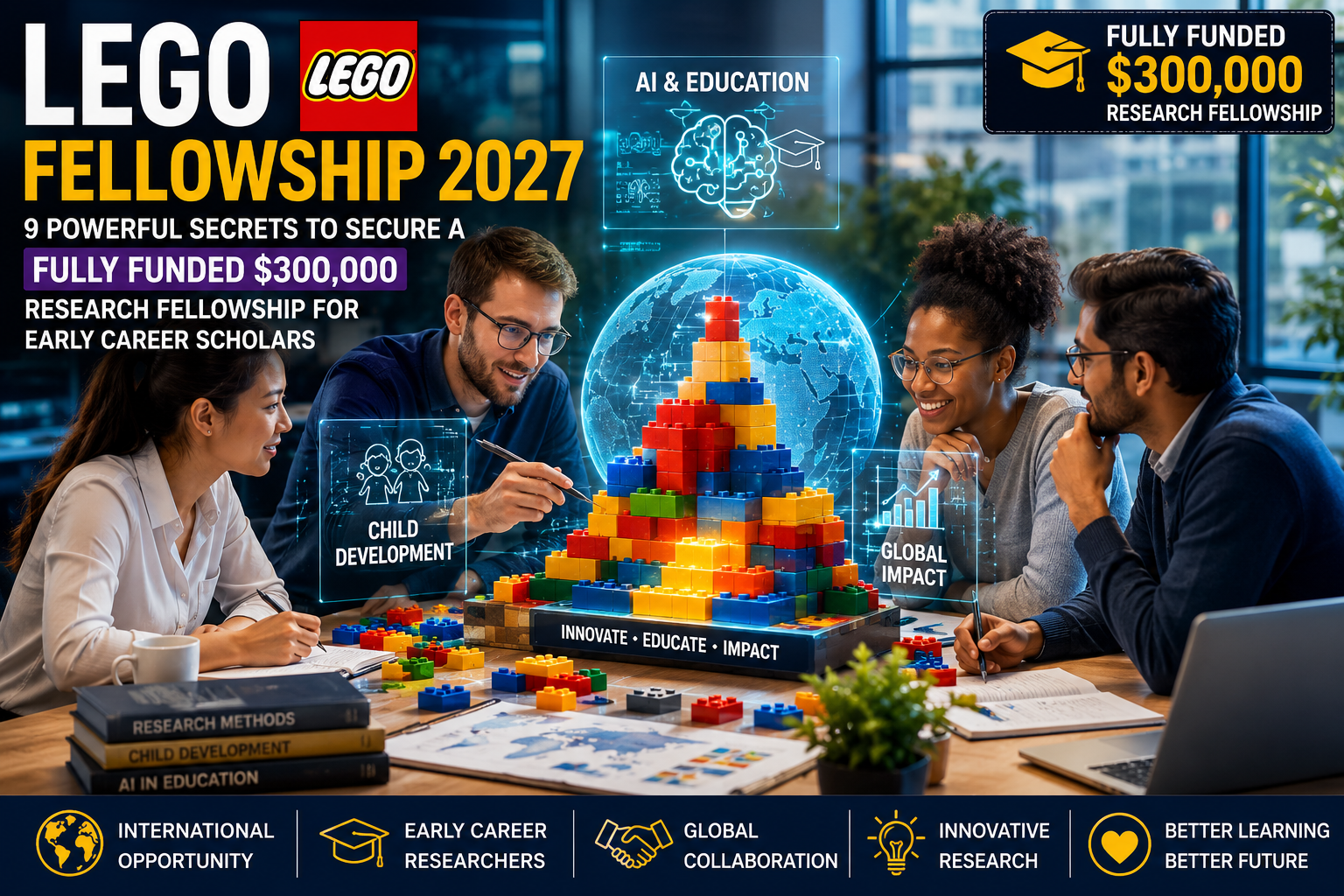
Why LEGO Fellowship 2027 Is a Game-Changer for Global Researchers
The LEGO Fellowship 2027 is emerging as one of the most talked-about opportunities in the global academic world, especially among early-career scholars focused on education, child development, and AI-enhanced learning systems. With funding that can reach up to $300,000, this fellowship represents more than financial support—it is a platform for innovation, global collaboration, and long-term academic influence.
Unlike many Research Fellowships 2027, this program stands out because it focuses not only on academic excellence but also on real-world impact in children’s learning environments. Scholars are encouraged to explore how technology, creativity, and education intersect in modern society.
In this detailed guide, we will break down everything you need to know—from eligibility to application secrets—so you can understand exactly how to position yourself competitively.

Eligibility and Requirements Explained Clearly
LEGO Fellowship 2027 Eligibility and Requirements Guide
To successfully compete for this prestigious fellowship, applicants must understand the core eligibility structure. While exact yearly updates may vary, the general expectations remain consistent across similar global fellowships.
Core Eligibility Requirements
Applicants for the LEGO Fellowship 2027 typically must:
- Hold a PhD or be in the final stages of doctoral completion
- Demonstrate strong research experience in education, child development, or AI learning systems
- Show evidence of published academic work or peer-reviewed research
- Be an early-career scholar (usually within 5–7 years post-PhD)
- Have a clear research proposal aligned with child learning innovation
- Be willing to collaborate internationally with interdisciplinary teams
Key Skills Required
- Strong academic writing ability
- Research methodology expertise
- Data analysis skills (quantitative or qualitative)
- Understanding of AI in education systems
- Policy impact awareness
The LEGO Fellowship 2027 eligibility and requirements guide emphasizes not just academic excellence but innovation-driven thinking.
What Makes It Different from Other Research Fellowships 2027
Unlike traditional academic funding, this fellowship integrates creativity, education, and technology.
LEGO Fellowship 2027 Key Distinctions
| Feature | LEGO Fellowship 2027 | Traditional Research Fellowships 2027 |
|---|---|---|
| Funding | Up to $300,000 | $20,000 – $150,000 |
| Focus Area | AI, Education, Child Development | Broad academic disciplines |
| Collaboration | Global interdisciplinary teams | Often single-institution based |
| Impact Goal | Practical learning transformation | Academic publication focus |
| Flexibility | High research freedom | Structured research goals |
This comparison shows why the LEGO Fellowship 2027 is considered one of the most competitive Fully Funded Fellowships globally.
How to Apply for LEGO Foundation Research Fellowship 2027
Step-by-Step Application Process
The application process is designed to identify innovative thinkers rather than just academic performers.
Step 1: Prepare a Strong Research Proposal
Your proposal should include:
- Clear research problem statement
- Objectives and expected outcomes
- Relevance to child development or AI education
- Methodology (qualitative or quantitative)
- Expected global impact
Step 2: Build Academic Evidence
Applicants must showcase:
- Publications
- Conference presentations
- Collaborative research experience
Step 3: Submit Online Application
Applications are typically submitted through official fellowship portals.
Official reference:
LEGO Foundation Fellowship Program Overview
Step 4: Interview and Evaluation
Shortlisted candidates are usually invited for:
- Academic interviews
- Proposal defense
- Research feasibility review
Step 5: Final Selection
Finalists are selected based on:
- Innovation potential
- Global relevance
- Research clarity
- Interdisciplinary strength
International AI and Child Development Fellowship 2027 Application Process
One of the strongest aspects of this fellowship is its focus on AI in education and child development research.
Why AI Matters in This Fellowship
Modern education systems are rapidly integrating:
- Machine learning for personalized education
- AI tutoring systems
- Data-driven child psychology studies
This is why many applicants are now searching for international AI and child development fellowship 2027 application process as a key keyword.
Key Research Areas Include:
- Digital learning environments
- Cognitive development in children
- AI-assisted teaching tools
- Inclusive education technologies
Supporting academic reference:
SSRC LEGO Foundation Research Fellowship Announcement
LEGO Fellowship 2027: 9 Powerful Secrets to Secure Success
Now let’s move into the most important section—strategies that significantly improve your chances.
Secret 1: Align Your Research with Global Impact Goals
Your proposal must show global relevance, not just academic curiosity.
Secret 2: Focus on Interdisciplinary Research
Combine:
- Education + AI
- Psychology + Technology
- Policy + Child Development
Secret 3: Publish Early and Often
Strong publication history increases credibility.
Secret 4: Build International Collaborations
Work with global researchers or institutions.
Secret 5: Write a Problem-Solving Proposal
Avoid theoretical-only proposals.
Secret 6: Demonstrate Policy Impact
Show how your research influences education systems.
Secret 7: Highlight Innovation in AI Education
Explain how your research improves learning outcomes.
Secret 8: Prepare for Academic Interview Questions
Expect questions on:
- Methodology
- Research impact
- Ethical considerations
Secret 9: Apply Early and Strategically
Early submission increases review attention and reduces errors.
Fully Funded $300,000 Research Fellowship Explained
The funding structure is one of the biggest attractions.
What the Funding Covers
- Research expenses
- Travel and fieldwork
- Data collection tools
- Academic collaboration costs
- Living allowances (in some cases)
This makes it one of the most competitive Fully Funded Fellowships globally.
Common Mistakes Applicants Must Avoid
Many candidates fail due to simple errors:
- Weak research proposal clarity
- Lack of interdisciplinary focus
- Ignoring AI integration relevance
- Poor academic writing structure
- Missing global impact framing
Comparison with Other PhD Fellowships Abroad
How It Stands Among PhD Fellowships Abroad
- Higher funding than most global fellowships
- Strong focus on innovation and education technology
- More competitive selection process
- Higher global visibility for researchers
This makes it a top choice among PhD Fellowships Abroad seekers.
Selection Criteria and Evaluation Process Explained
Understanding how the LEGO Fellowship 2027 selects its candidates is one of the most important steps for any early-career researcher aiming to secure this highly competitive opportunity. Unlike many traditional Research Fellowships 2027, this fellowship does not rely solely on academic grades or publication count. Instead, it uses a holistic evaluation system that prioritizes innovation, global impact, and the ability to transform learning outcomes for children.
At its core, the selection process is designed to identify researchers who can meaningfully contribute to AI-driven education systems, child development studies, and inclusive learning innovation.
LEGO Fellowship 2027 Selection Criteria Overview
The evaluation process typically focuses on five major pillars:
1. Research Innovation and Originality
Applicants must present research ideas that go beyond conventional academic work.
Reviewers look for:
- Fresh perspectives in education or child development
- Integration of technology such as AI or digital learning tools
- Problem-solving approaches that address real-world learning challenges
A strong LEGO Fellowship 2027 eligibility and requirements guide always emphasizes originality as a core requirement.
2. Academic Background and Research Experience
While the fellowship is open to early-career scholars, a solid academic foundation is still essential.
Successful applicants usually demonstrate:
- A completed PhD or near-completion status
- Published research in peer-reviewed journals
- Participation in international academic conferences
- Experience in interdisciplinary research environments
However, the fellowship places more weight on research potential than academic prestige alone.
3. Alignment with AI, Education, and Child Development Goals
One of the most defining features of the LEGO Fellowship 2027 is its strong focus on children’s learning in a rapidly digital world.
Applicants are evaluated based on how well their research aligns with:
- AI-powered education systems
- Cognitive development in children
- Inclusive and accessible learning environments
- Digital transformation in classrooms
According to the LEGO Foundation’s research priorities, the organization strongly supports studies that improve learning through play and innovation in education systems.
Reference: LEGO Foundation Research Focus Areas
4. Feasibility and Real-World Impact of the Research
Beyond theory, reviewers want to see practical outcomes.
Your proposal should clearly explain:
- How the research will be implemented in real educational settings
- The expected measurable outcomes
- The scalability of the project across different countries or regions
- Its long-term contribution to education policy or child welfare
This is especially important in international AI and child development fellowship 2027 application process evaluations.
5. Communication Skills and Proposal Clarity
Even the strongest research idea can fail if it is poorly presented.
Selection committees assess:
- Clarity of writing and structure
- Logical flow of research arguments
- Ability to explain complex ideas simply
- Strong academic storytelling
A well-written proposal often determines whether an applicant advances to the interview stage.
LEGO Fellowship 2027 Evaluation Process (Step-by-Step)
While exact procedures may vary each year, the general evaluation flow includes:
Step 1: Initial Screening
Applications are reviewed for:
- Eligibility compliance
- Completeness of documents
- Alignment with fellowship focus areas
Step 2: Academic Shortlisting
A panel evaluates:
- Research quality
- Academic record
- Proposal strength
Only a small percentage progresses beyond this stage.
Step 3: Expert Peer Review
External experts in education, AI, and child development assess:
- Methodological soundness
- Innovation level
- Potential global contribution
Step 4: Interview Stage
Shortlisted candidates may be invited for:
- Research presentation
- Q&A with academic reviewers
- Discussion of feasibility and impact
Step 5: Final Selection
Final decisions are based on:
- Overall research excellence
- Interdisciplinary strength
- Alignment with the LEGO Foundation mission
- Potential to influence global education systems
Why This Selection Process Matters
The LEGO Fellowship 2027 is not just another academic funding program—it is designed to identify researchers who can actively reshape how children learn in a technology-driven world. That is why the selection process is highly detailed and competitive.
Understanding these criteria gives applicants a strategic advantage when preparing their fully funded $300,000 research fellowship for early career scholars application.
Common Reasons for Application Rejection and How to Avoid Them
The LEGO Fellowship 2027 is one of the most competitive Fully Funded Fellowships for early-career researchers, especially those working in AI, education, and child development. While many applicants submit strong academic profiles, only a small percentage are selected. Understanding why applications fail is just as important as knowing how to apply.
This section breaks down the most common rejection reasons and how you can strategically avoid them in your how to apply for LEGO Foundation research fellowship 2027 process.
1. Weak or Unfocused Research Proposal
One of the biggest reasons applications are rejected is a poorly defined research idea. Many applicants fail because their proposal is either too broad, too theoretical, or lacks a clear problem statement.
Common mistakes include:
- Vague research questions without measurable outcomes
- Overly broad topics (e.g., “improving education globally”)
- Lack of focus on child development or AI integration
- No clear methodology or research design
How to avoid it:
To succeed in the LEGO Fellowship 2027 eligibility and requirements guide, your proposal must:
- Focus on a specific problem in education or child learning
- Clearly define objectives and outcomes
- Show how AI or innovation improves learning systems
- Include a realistic and structured methodology
A strong proposal should feel like a real-world solution, not just an academic idea.
2. Poor Alignment with LEGO Foundation Priorities
Even strong researchers are rejected when their work does not align with the fellowship’s mission.
The LEGO Fellowship 2027 strongly prioritizes:
- Child-centered learning research
- Play-based education models
- AI-driven learning environments
- Inclusive and equitable education systems
If your proposal does not clearly connect to these areas, it may be considered irrelevant.
LEGO Foundation research priorities emphasize learning through play and innovation in education systems
https://www.legofoundation.com/en/what-we-do/research/
3. Lack of Interdisciplinary Thinking
Modern Research Fellowships 2027 increasingly value interdisciplinary research. The LEGO Fellowship is no exception.
Common rejection pattern:
Applicants focus only on one discipline (e.g., education alone or computer science alone), without combining fields.
Why this matters:
The fellowship is designed for research at the intersection of:
- Education + Artificial Intelligence
- Psychology + Child Development
- Technology + Learning Systems
How to improve:
Your application should clearly demonstrate:
- Cross-disciplinary expertise
- Collaboration across fields
- Integration of multiple research methods
This is especially critical in the international AI and child development fellowship 2027 application process.
4. Weak Academic Evidence or Research Track Record
While the fellowship supports early-career scholars, applicants are still expected to show credible academic engagement.
Common issues include:
- No peer-reviewed publications
- Limited research experience
- Weak academic CV
- No international exposure
How to strengthen your profile:
- Publish at least 1–3 academic papers before applying
- Participate in conferences or workshops
- Collaborate with established researchers
- Build a visible research portfolio online (Google Scholar, ORCID)
Even strong ideas may be rejected if the applicant lacks research credibility.
5. Poorly Written or Unclear Application Documents
A surprising number of applications fail simply due to poor writing quality.
Common writing issues:
- Unstructured proposals
- Grammar and clarity problems
- Lack of logical flow
- Overuse of jargon without explanation
Why this matters:
Reviewers handle hundreds of applications. If your proposal is hard to read, it will not stand out.
Solution:
- Use clear headings and structured formatting
- Write in simple academic English
- Explain technical terms clearly
- Ensure logical progression of ideas
A well-written application often outperforms a stronger idea that is poorly communicated.
6. Unrealistic Research Scope
Another major rejection reason is proposing work that is too ambitious for the fellowship timeline or funding scope.
Examples of unrealistic scope:
- Attempting global education system reform in one project
- Collecting data from too many countries without resources
- Overly complex AI systems without technical feasibility
How to fix it:
- Focus on achievable, measurable outcomes
- Define clear geographic or demographic limits
- Ensure your project fits within the fellowship timeline and budget
Remember: the fully funded $300,000 research fellowship for early career scholars is powerful—but still requires realistic planning.
7. Weak Demonstration of Impact
The LEGO Foundation is impact-driven. Applications that fail to show real-world benefits are often rejected.
What reviewers expect:
- Clear contribution to education systems
- Evidence of social or developmental impact
- Practical applications in schools or learning environments
Strong applications show not just what you will study, but why it matters globally.
Turning Rejection Risks into Winning Strategy
Understanding rejection reasons is one of the most powerful advantages in preparing for the LEGO Fellowship 2027. Most applicants fail not because they lack intelligence, but because they fail to align their proposal with the fellowship’s core mission.
If you can:
- Sharpen your research focus
- Align with LEGO Foundation priorities
- Strengthen your academic credibility
- Communicate your ideas clearly
…you dramatically increase your chances of success in this highly competitive PhD Fellowships Abroad category.

Benefits, Career Opportunities, and Long-Term Research Impact
The LEGO Fellowship 2027 is not just another entry in the list of Fully Funded Fellowships—it is a career-defining opportunity designed to reshape how early-career researchers contribute to global education, AI innovation, and child development. With funding that can reach up to $300,000, this fellowship provides far more than financial support; it offers visibility, collaboration, and long-term academic influence.
For many scholars exploring PhD Fellowships Abroad, the LEGO Fellowship represents a rare blend of funding, freedom, and future-proof research direction.
Immediate Benefits for Early-Career Scholars
One of the biggest attractions of the LEGO Fellowship 2027 eligibility and requirements guide is the wide range of immediate benefits awarded to selected researchers.
1. Substantial Research Funding
Successful applicants may receive up to $300,000 in research support, which can be used for:
- Fieldwork and data collection
- Research assistant hiring
- International collaboration visits
- AI tools and educational technology development
- Conference participation
This makes it one of the most competitive Research Fellowships 2027 globally in terms of financial backing.
2. Freedom to Explore Innovative Research Ideas
Unlike traditional grants that impose strict limitations, this fellowship encourages intellectual freedom.
Researchers are given space to:
- Explore experimental education models
- Integrate AI into child learning systems
- Test new cognitive development theories
- Design innovative learning environments
This flexibility is one of the key reasons applicants search for how to apply for LEGO Foundation research fellowship 2027 so intensely.
3. Global Academic Visibility
Being selected for the LEGO Fellowship 2027 places researchers on an international platform.
Benefits include:
- Recognition from global education institutions
- Opportunities to publish in high-impact journals
- Invitations to international research conferences
- Increased academic credibility
This visibility often becomes a turning point in an academic career.
Long-Term Career Opportunities
Beyond immediate benefits, the long-term career impact of the fellowship is even more significant.
1. Academic Career Advancement
Many past fellowship recipients often progress into:
- Tenured university positions
- Senior research leadership roles
- Policy advisory positions in education ministries
- Think tank and global research organizations
The fellowship acts as a strong credential in the academic job market.
2. Access to Global Research Networks
One of the most valuable aspects of the fellowship is the network it provides.
Researchers gain access to:
- International education experts
- AI and learning technology specialists
- Child development research communities
- Policy makers and global institutions
This network often leads to long-term collaborations even after the fellowship ends.
3. Influence on Education Policy and Innovation
The international AI and child development fellowship 2027 application process strongly emphasizes real-world impact.
Selected researchers often contribute to:
- National education reforms
- Digital learning policies
- Child-centered learning frameworks
- AI ethics in education systems
This ensures that research outcomes are not just theoretical but actively shape global education systems.
Comparison of Career Impact vs Other Fellowships
| Feature | LEGO Fellowship 2027 | Typical PhD Fellowships Abroad |
|---|---|---|
| Funding Level | Up to $300,000 | $20,000 – $150,000 |
| Research Freedom | High | Moderate |
| Global Recognition | Very High | Medium |
| AI & Education Focus | Strong Specialized Focus | General Research |
| Policy Impact | High | Variable |
This comparison shows why the LEGO Fellowship 2027 stands out among elite Fully Funded Fellowships worldwide.
Long-Term Research Impact on Society
Beyond individual career growth, the fellowship contributes to broader societal transformation.
1. Advancing AI in Education
Research funded by the fellowship often explores:
- Adaptive learning systems
- Personalized AI tutoring tools
- Data-driven education systems
This helps shape the future of global classrooms.
2. Improving Child Development Outcomes
A major focus of the LEGO Foundation Fellowship 2027 is understanding how children learn best.
Research contributes to:
- Better early education strategies
- Improved cognitive development frameworks
- Inclusive learning methods for diverse learners
3. Strengthening Global Education Equity
Many fellowship projects address inequality in education access by:
- Designing low-cost learning tools
- Supporting underserved communities
- Improving digital access to education
This ensures that the fellowship has a global humanitarian impact.
Why It Is a Life-Changing Opportunity
The real value of the LEGO Fellowship 2027 is not just in funding or prestige—it lies in transformation.
For early-career researchers, it offers:
- A platform to launch an international academic career
- Financial freedom to focus fully on research
- Opportunities to influence global education systems
- A long-lasting professional network
This is why it continues to rank among the most searched Research Fellowships 2027 opportunities globally.
The True Value of LEGO Fellowship 2027
The LEGO Fellowship 2027 is more than a scholarship—it is a gateway into global academic leadership. It empowers researchers to move beyond traditional boundaries and contribute meaningfully to the future of education, AI, and child development.
For scholars aiming to stand out in the competitive world of PhD Fellowships Abroad, this fellowship offers not just funding, but influence, innovation, and long-term career growth.
Final Thoughts and Conclusion
The LEGO Fellowship 2027 is not just a financial opportunity—it is a career-defining platform for early-career researchers who want to shape the future of education, AI, and child development.
If approached strategically, this fellowship can:
- Elevate your academic career globally
- Provide access to international research networks
- Fund transformative educational research
- Position you as a thought leader in AI education
For scholars aiming to stand out in the competitive world of Research Fellowships 2027, this is one of the most powerful opportunities available.
FINAL INSIGHT
Success in the LEGO Fellowship 2027 is not about being the smartest applicant—it is about being the most aligned with global educational transformation goals.
Leave a Reply