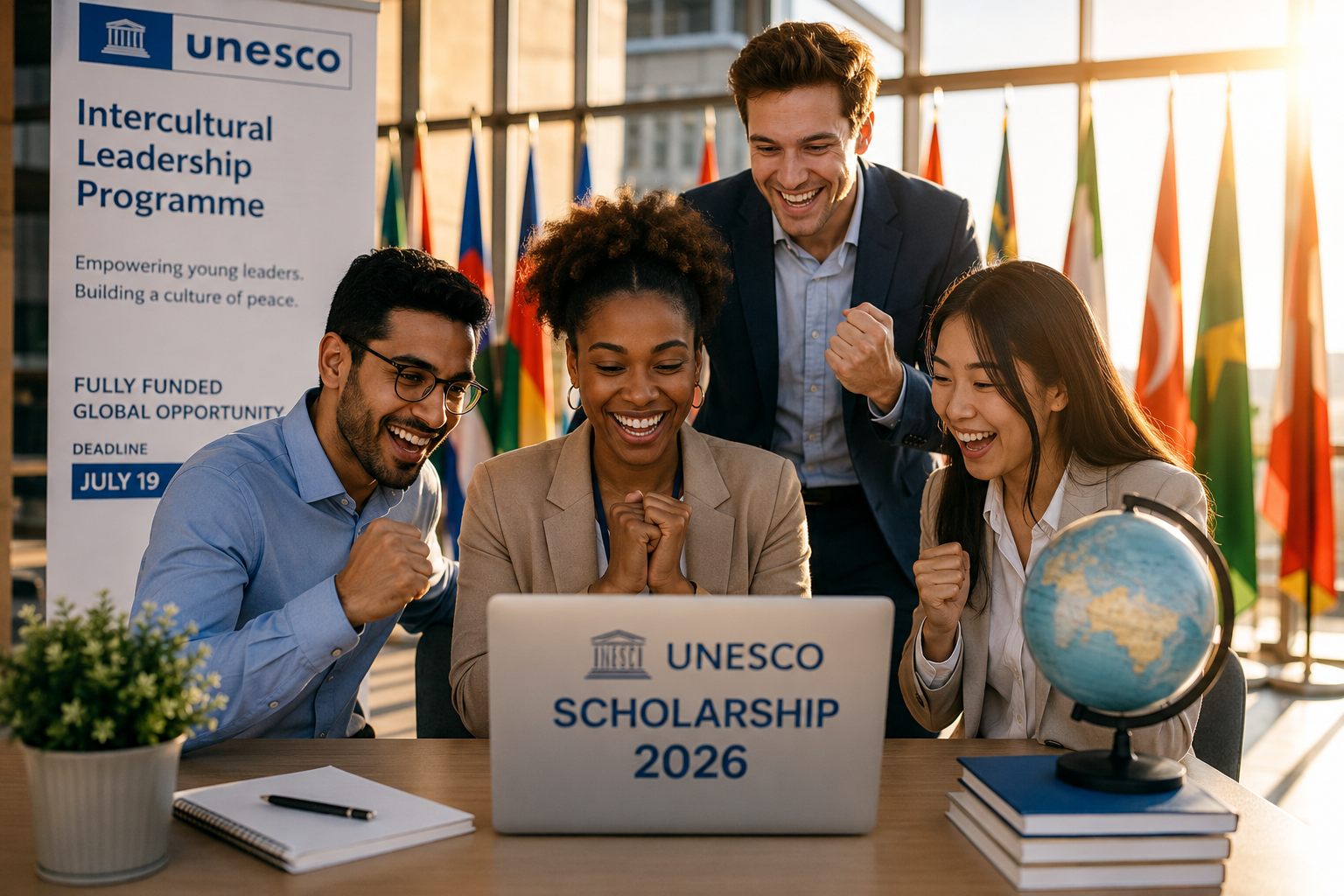
Imagine receiving an email informing you that you have been selected by UNESCO to join an exclusive global network of emerging leaders. Picture yourself collaborating with professionals from different continents, receiving mentorship from internationally recognized experts, leading a funded community project, and representing your country on a global platform.
For many people, opportunities like this seem almost impossible to obtain. Yet every year, determined applicants from around the world earn a place by submitting thoughtful, well-prepared applications.
That is exactly why the UNESCO Scholarship 2026 has attracted enormous attention. Unlike many international opportunities that focus solely on academic excellence, the UNESCO Fully Funded Program looks for people who have already begun creating meaningful change in their communities and are ready to scale that impact globally.
With the July 19, 2026 application deadline approaching quickly, thousands of applicants are now searching for accurate information about eligibility, application requirements, selection criteria, and practical strategies that can improve their chances of success.
If you are serious about becoming one of UNESCO’s next global leaders, this comprehensive guide will walk you through everything you need to know.

UNESCO Scholarship 2026: Understanding the Fully Funded Intercultural Leadership Programme
The UNESCO Scholarship 2026 refers to the Youth for Peace: UNESCO Intercultural Leadership Programme, one of UNESCO’s flagship international leadership initiatives aimed at identifying and empowering emerging leaders from across the world.
Rather than functioning as a traditional university scholarship, this programme focuses on leadership development, intercultural dialogue, peacebuilding, and community transformation.
Selected participants receive intensive leadership training, mentorship, international networking opportunities, financial support for community projects, and the opportunity to join UNESCO’s growing network of global changemakers. The programme seeks individuals who are already making measurable contributions to society and who demonstrate the potential to influence positive change on a much larger scale.
- UNESCO Youth for Peace – Intercultural Leadership Programme (Official Programme Information): https://www.unesco.org/en/interculturaldialogue/youthforpeace
UNESCO Scholarship 2026 at a Glance
| Feature | Details |
|---|---|
| Programme Name | Youth for Peace: UNESCO Intercultural Leadership Programme |
| Host Organization | UNESCO |
| Programme Type | Fully Funded International Leadership Programme |
| Coverage | Leadership training, mentorship, networking, project funding and international participation |
| Eligible Applicants | Emerging leaders from eligible countries meeting programme requirements |
| Working Language | English |
| Application Deadline | July 19, 2026 (23:59 CET – Paris Time) |
| Focus Area | Peacebuilding, intercultural dialogue, leadership, community impact |
| Theme | Human Connection and Dialogue in the Age of AI |
| Official Application | UNESCO Online Portal |
Why the UNESCO Scholarship 2026 Is Different from Other Fully Funded Scholarships 2026
Every year, thousands of international scholarships become available.
Most focus on:
- Undergraduate studies
- Master’s degrees
- PhD research
- Professional certifications
The UNESCO Fully Funded Program stands apart because it is built around leadership transformation rather than academic enrollment.
UNESCO understands that solving today’s global challenges requires more than degrees. Communities need leaders who can unite people across cultures, encourage dialogue during conflict, promote inclusion, and design sustainable solutions to pressing social issues.
Instead of awarding tuition, the programme invests directly in people who already demonstrate leadership potential and provides them with the tools, knowledge, mentorship, and international exposure needed to amplify their impact.
UNESCO Scholarship 2026: Why Global Demand Is Rising
Search interest in the UNESCO Scholarship 2026 has grown significantly because international applicants are increasingly seeking opportunities that combine funding with long-term career development.
Several trends explain this surge in popularity.
1. International Recognition
Having UNESCO on your professional profile immediately enhances credibility. UNESCO is one of the world’s most respected organizations in education, science, culture, and peacebuilding.
2. Leadership Development
Unlike conventional scholarships, participants receive structured leadership training that equips them to solve complex real-world problems.
3. Global Professional Network
Participants collaborate with outstanding leaders from different countries, creating lifelong professional relationships that often lead to future partnerships and career opportunities.
4. Financial Support
Successful applicants receive financial assistance to implement impactful community projects, allowing them to transform ideas into measurable results.
UNESCO Fully Funded Program: What Makes It So Competitive?
Every year, UNESCO receives applications from exceptionally talented individuals across the globe.
Many applicants have:
- Years of leadership experience
- Strong academic backgrounds
- Community development experience
- NGO leadership
- Youth advocacy experience
- Public policy experience
- Entrepreneurship achievements
- Peacebuilding initiatives
However, impressive résumés alone rarely guarantee selection.
The review committee evaluates applicants holistically, considering qualities such as:
- Authentic leadership
- Long-term vision
- Community impact
- Cultural sensitivity
- Collaboration skills
- Emotional intelligence
- Ability to inspire others
- Innovation
- Commitment to intercultural dialogue
In other words, UNESCO is searching for individuals who do not simply lead—they bring people together despite differences.
Who Should Apply for the UNESCO Scholarship 2026?
This opportunity is ideal for professionals and emerging leaders who have demonstrated a genuine commitment to improving society.
Strong candidates often include:
- Youth leaders
- NGO founders
- Social entrepreneurs
- Educators
- Community organizers
- Civil society advocates
- Researchers
- Policy professionals
- Peacebuilders
- Cultural ambassadors
- Human rights advocates
- Environmental leaders
- Innovation specialists
You do not need to be a celebrity or hold a senior government position.
What matters most is your ability to demonstrate measurable impact and your willingness to continue creating positive change after completing the programme.
UNESCO Scholarship 2026: Why You Should Apply Before the July 19 Deadline
Waiting until the final days to prepare your application is one of the biggest mistakes applicants make.
Preparing a competitive application requires time to:
- Review eligibility criteria carefully.
- Prepare a polished CV.
- Develop a compelling community project idea.
- Gather supporting documents.
- Create a persuasive personal statement.
- Obtain any required supporting information.
- Review your application multiple times before submission.
Submitting early also reduces the risk of technical issues close to the application deadline. According to UNESCO’s official call, applications close on 19 July 2026 at 23:59 CET (Paris time). (UNESCO)
For the official programme details and application portal, visit:
UNESCO Scholarship 2026 Eligibility and Requirements
One of the biggest reasons applicants are rejected is surprisingly simple—they fail to meet the eligibility criteria before spending hours preparing their application.
The UNESCO Scholarship 2026 is highly competitive, but UNESCO is transparent about the type of candidates it is looking for. If you understand the UNESCO Fully Funded Intercultural Leadership Programme 2026 eligibility and requirements, you can quickly determine whether you are a suitable candidate and tailor your application accordingly.
Unlike traditional scholarships that primarily reward academic excellence, this programme places a strong emphasis on leadership potential, measurable community impact, and the ability to foster intercultural dialogue. UNESCO is looking for changemakers who can build bridges across cultures and contribute to peaceful, inclusive societies.
UNESCO Scholarship 2026 Eligibility and Requirements
To qualify for the UNESCO Fully Funded Program, applicants are generally expected to meet the following requirements.
Age Requirement
Applicants should be between 25 and 45 years old within the eligibility period specified in the official call for applications. This age range reflects the programme’s focus on emerging leaders who have already demonstrated meaningful professional or community leadership.
Leadership Experience
This programme is not designed for individuals who simply aspire to become leaders someday.
Instead, UNESCO expects applicants to already have a proven record of leadership through activities such as:
- Community development
- Youth empowerment
- Education initiatives
- Peacebuilding projects
- Human rights advocacy
- Environmental sustainability
- Social entrepreneurship
- Cultural preservation
- Public policy
- Non-profit leadership
Leadership does not necessarily mean holding a prestigious title. Many successful candidates lead grassroots initiatives, volunteer organizations, or local community projects that have created measurable positive change.
Commitment to Intercultural Dialogue
One of the defining features of the Leadership Programme 2026 is its emphasis on intercultural understanding.
Applicants should demonstrate that they have experience working with people from diverse:
- Cultural backgrounds
- Religious groups
- Ethnic communities
- Social identities
- Nationalities
- Languages
UNESCO values individuals who can resolve differences through dialogue rather than conflict.
English Language Proficiency
Since training sessions, mentorship, workshops, and project collaboration are conducted in English, participants must be able to communicate effectively in written and spoken English. Applicants confirm their proficiency during the application process.
Commitment to Participate Fully
Successful applicants are expected to participate in every component of the programme, including:
- Online leadership training
- Mentorship sessions
- Capacity-building workshops
- Community project implementation
- Virtual collaboration
- International networking events
- Final reporting activities
Applicants who cannot commit to the full programme may not be considered.
Who Has the Best Chance of Winning the UNESCO Scholarship 2026?
Although applicants come from different educational and professional backgrounds, the strongest candidates often share several characteristics.
They are individuals who:
- Have initiated projects that solve real community problems.
- Can demonstrate measurable results from their work.
- Inspire and motivate others.
- Work effectively with diverse groups.
- Think beyond local challenges and understand global issues.
- Show resilience and adaptability.
- Communicate ideas clearly and persuasively.
- Have a long-term vision for creating positive social change.
UNESCO is not looking for perfection. It is looking for authenticity, commitment, and evidence that your leadership can create lasting impact.
UNESCO Fully Funded Program Benefits
One reason the UNESCO Scholarship 2026 has become one of the most searched international opportunities is the exceptional range of benefits offered to selected participants.
Rather than providing only financial assistance, UNESCO invests in the long-term development of each participant as a global leader.
Some of the key benefits include:
1. Advanced Leadership Training
Participants receive intensive training in areas such as:
- Intercultural leadership
- Dialogue facilitation
- Systems thinking
- Collaborative problem-solving
- Peacebuilding strategies
- Community engagement
These are practical skills that can be applied immediately within participants’ communities and professional careers.
2. Mentorship from Global Experts
Every participant gains access to experienced mentors who provide guidance throughout the programme.
Mentors help participants:
- Refine project ideas.
- Strengthen leadership capacity.
- Navigate implementation challenges.
- Expand professional networks.
- Develop sustainable impact strategies.
This personalized support is one of the programme’s greatest strengths.
3. Financial Support for Community Projects
Unlike many leadership programmes that stop at training, UNESCO also provides financial support to help participants implement high-impact community initiatives aligned with the programme’s goals.
4. International Recognition
Being selected by UNESCO demonstrates that your leadership has been recognized by one of the world’s most respected international organizations.
This recognition can strengthen future applications for:
- Graduate scholarships
- International fellowships
- NGO positions
- United Nations opportunities
- Research grants
- Leadership awards
5. Global Networking Opportunities
Participants become part of an international network of emerging leaders representing dozens of countries.
These relationships often lead to:
- International collaborations
- Joint research
- Cross-border projects
- Speaking invitations
- Career opportunities
- Lifelong professional partnerships
Benefits Overview
| Benefit | What You Receive | Long-Term Value |
|---|---|---|
| Leadership Training | Intensive capacity-building workshops | Strong leadership and project management skills |
| Mentorship | Guidance from experienced international experts | Professional growth and strategic advice |
| Project Funding | Financial support for community initiatives | Ability to create measurable local impact |
| Global Network | Connections with leaders from many countries | International collaborations and career opportunities |
| UNESCO Recognition | Membership in a prestigious global programme | Enhanced credibility and future opportunities |
| International Exposure | Access to UNESCO platforms and events | Greater visibility for your work |
Why the UNESCO Scholarship 2026 Is Worth Applying For
Many international opportunities end once participants complete a workshop or conference.
The UNESCO Fully Funded Program is different because it is designed to create a lasting community of leaders. Participants continue engaging through alumni networks, collaborative initiatives, and future UNESCO-led opportunities, allowing the benefits of the programme to extend well beyond the initial training period. (UNESCO)
UNESCO Scholarship 2026: 10 Powerful Steps to Prepare a Strong Application for the Fully Funded Intercultural Leadership Programme
Securing a place in the UNESCO Scholarship 2026 is about much more than meeting the minimum eligibility requirements. Every application is reviewed alongside submissions from talented changemakers around the world, many of whom have impressive academic records and years of leadership experience.
What often distinguishes successful applicants is not the number of certificates they hold, but how clearly they communicate their leadership journey, community impact, and future vision. A well-prepared application tells a coherent story: who you are, what you’ve accomplished, why your work matters, and how participating in the UNESCO Fully Funded Program will help you create even greater impact.
The following ten steps are designed to help you prepare an authentic, organized, and compelling application that aligns with UNESCO’s published objectives.
1. Understand the Goals of the UNESCO Scholarship 2026 Before You Apply
Before filling out a single application field, take time to understand what the programme is trying to achieve.
The Leadership Programme 2026 is not simply looking for individuals with excellent grades or prestigious job titles. UNESCO’s mission is to support emerging leaders who can foster intercultural dialogue, encourage peaceful collaboration, and create meaningful change within their communities.
As you review the programme information, ask yourself:
- How does my work contribute to social impact?
- Have I promoted inclusion or dialogue among diverse groups?
- What leadership experiences best reflect UNESCO’s values?
- How can I demonstrate long-term commitment to community development?
Understanding these objectives will help you ensure that every section of your application reflects the programme’s priorities rather than simply listing achievements.
2. Demonstrate Genuine Leadership Through Real-World Impact
Leadership is one of the most important aspects of the UNESCO Fully Funded Intercultural Leadership Programme 2026 eligibility and requirements.
Rather than making broad statements such as “I am a passionate leader,” focus on specific examples that illustrate your impact.
Consider describing:
- A community initiative you organized.
- A challenge you helped solve.
- A project that improved people’s lives.
- A volunteer programme you coordinated.
- A campaign that promoted education, inclusion, or environmental sustainability.
Whenever possible, include measurable outcomes.
For example:
- Number of people reached.
- Volunteers recruited.
- Workshops delivered.
- Communities served.
- Funds raised.
- Partnerships established.
Concrete examples help reviewers understand the scale and significance of your contributions.
3. Write a Personal Statement That Reflects Your Authentic Story
Your motivation statement is one of the most important parts of the application.
Instead of trying to sound overly formal or using complex language, focus on telling your story in a clear and sincere way.
A strong personal statement should answer questions such as:
- What inspired your leadership journey?
- What challenges have shaped your perspective?
- What problem are you most passionate about solving?
- How has your work created positive change?
- Why is intercultural dialogue important to you?
- How will this programme help you expand your impact?
Avoid generic statements that could apply to anyone. The most memorable applications are those that clearly connect personal experiences with future aspirations.
4. Highlight Your Experience Working Across Cultures
Intercultural dialogue is at the heart of the UNESCO Fully Funded Program.
Reviewers will be interested in learning how you have collaborated with people from different backgrounds and how those experiences have influenced your leadership style.
You might discuss experiences such as:
- Working with multicultural teams.
- Organizing community events that brought diverse groups together.
- Participating in international exchange programmes.
- Supporting marginalized communities.
- Promoting inclusion in educational or professional settings.
Even local experiences can demonstrate intercultural competence if they show respect, collaboration, and understanding across different communities.
5. Present a Clear Vision for Future Impact
UNESCO is interested not only in what you have already accomplished but also in what you hope to achieve.
Your application should communicate a realistic vision for the future.
Think about questions like:
- What long-term change do you want to create?
- How will participating in this programme strengthen your work?
- What new skills do you hope to develop?
- How will you apply what you learn to benefit your community?
A thoughtful vision shows that you see the programme as an opportunity for growth and continued service, not simply as an award to add to your résumé.
6. Prepare the Required Documents Carefully
A complete application is essential. Missing or poorly prepared documents can delay or weaken your submission.
The UNESCO Fully Funded Intercultural Leadership Programme 2026 deadline July 19 and required documents may include items such as:
- A current curriculum vitae (CV) or résumé.
- A completed online application form.
- A motivation or personal statement.
- Information about your leadership experience.
- Details of your proposed community project or initiative.
- Any additional supporting materials requested in the official application portal.
Before submitting, review each document carefully to ensure it is accurate, well-organized, and free of spelling or formatting errors.
7. Proofread Every Part of Your Application
A polished application reflects professionalism and attention to detail.
Before you submit:
- Read every response aloud.
- Check grammar and spelling.
- Verify dates and contact information.
- Ensure your examples are consistent throughout the application.
- Remove repetitive or unnecessary content.
If possible, ask a trusted mentor, colleague, or friend to review your application and provide constructive feedback.
8. Manage Your Time and Avoid Last-Minute Submissions
One of the simplest ways to reduce unnecessary stress is to begin preparing your application well before the deadline.
Creating a preparation timeline can help you stay organized.
| Task | Suggested Timeline |
|---|---|
| Review programme requirements | 3–4 weeks before deadline |
| Draft personal statement | 2–3 weeks before deadline |
| Update CV | 2 weeks before deadline |
| Gather supporting information | 1–2 weeks before deadline |
| Proofread and revise | Final week |
| Submit application | At least 2–3 days before July 19 |
Submitting early also gives you time to address any technical issues that might arise during the online application process.
9. Stay Authentic Throughout the Application
One of the strongest qualities an application can demonstrate is authenticity.
Rather than trying to guess what reviewers want to hear, focus on presenting an honest account of your experiences, challenges, and aspirations.
Authenticity builds credibility and allows your unique perspective to stand out.
Remember that meaningful leadership is not defined solely by the size of a project but by the positive difference it makes in people’s lives.
10. Review Everything Before You Click Submit
Before submitting your application, complete one final review.
Use this checklist:
- Have you answered every required question?
- Is your CV up to date?
- Have you clearly explained your leadership experience?
- Have you described your community impact with specific examples?
- Is your motivation statement clear and genuine?
- Have you checked all spelling and grammar?
- Have you uploaded every required document?
- Have you confirmed that all information is accurate?
Taking a few extra minutes for a final review can help ensure that your application is complete and reflects your best work.
Why Preparation Matters
The UNESCO Scholarship 2026 is a prestigious opportunity that attracts applicants from around the world. While the selection process is competitive, a thoughtful, well-prepared application allows reviewers to clearly understand your experiences, your commitment to intercultural dialogue, and the positive impact you hope to create.
Approaching the process with authenticity, careful preparation, and attention to detail will help you submit an application that accurately represents your leadership journey and aligns with the programme’s published objectives.
Required Documents for the UNESCO Scholarship 2026
Preparing your documents well in advance is one of the smartest things you can do before the application deadline. A complete, organized application not only demonstrates professionalism but also ensures that reviewers can focus on your qualifications rather than missing information.
While applicants should always follow the latest instructions published in the official application portal, the UNESCO Fully Funded Intercultural Leadership Programme 2026 deadline July 19 and required documents generally include the following.
| Required Document | Purpose | Tips |
|---|---|---|
| Completed Online Application Form | Provides your personal and professional information | Fill out every required section accurately. |
| Updated Curriculum Vitae (CV) | Summarizes your education, leadership experience, and achievements | Keep it concise, professional, and relevant. |
| Motivation Statement | Explains why you are applying and how the programme aligns with your goals | Use authentic examples and avoid generic language. |
| Leadership Experience Details | Demonstrates your community impact | Highlight measurable achievements wherever possible. |
| Community Project Information (if requested) | Shows your proposed or ongoing initiative | Explain the problem, your solution, and expected impact. |
| Supporting Information | Any additional materials requested by UNESCO | Double-check the application portal for specific instructions. |
Tip: Use consistent formatting across all documents. Simple fonts, clear headings, and error-free writing create a stronger first impression.
UNESCO Scholarship 2026 Application Timeline
Many applicants underestimate how much time it takes to prepare a competitive application. Breaking the process into smaller tasks can help you stay organized and reduce last-minute pressure.
Suggested Preparation Timeline
| Timeline | Recommended Action |
|---|---|
| 4 Weeks Before Deadline | Read the official programme guidelines carefully. |
| 3 Weeks Before Deadline | Update your CV and gather leadership examples. |
| 2 Weeks Before Deadline | Draft and refine your motivation statement. |
| 10 Days Before Deadline | Review all required documents and check for completeness. |
| 1 Week Before Deadline | Ask a trusted mentor or colleague to review your application. |
| 2–3 Days Before Deadline | Upload documents and complete the online submission. |
| Before July 19 | Submit your application and retain a copy for your records. |
Planning ahead gives you enough time to revise your responses thoughtfully rather than rushing through the final stages.
Common Mistakes to Avoid When Applying for the UNESCO Scholarship 2026
Even highly qualified candidates can weaken their applications by making avoidable mistakes. Being aware of these common issues can help you present your strongest possible application.
1. Ignoring the Official Instructions
Every programme has its own requirements. Carefully read the application guidelines before preparing your documents to ensure that you meet all published criteria.
2. Submitting an Incomplete Application
Missing information or required documents may result in your application being considered incomplete.
Before submitting, verify that:
- Every required question has been answered.
- All requested documents have been uploaded.
- Contact information is correct.
- Dates and employment history are accurate.
3. Using Generic Responses
Reviewers read many applications. Statements such as “I want to make the world a better place” become much more meaningful when supported by real examples of your work.
Instead of making broad claims, explain:
- What you did.
- Why it mattered.
- What results were achieved.
- What you learned from the experience.
4. Poor Organization
Long paragraphs without structure can make your application difficult to follow.
Use:
- Clear examples.
- Logical flow.
- Short paragraphs where appropriate.
- Consistent formatting.
Good organization helps reviewers understand your experiences more easily.
5. Waiting Until the Last Minute
Submitting close to the deadline increases the risk of technical problems, overlooked errors, or incomplete responses.
Whenever possible, aim to submit your application several days before the official closing date.
How Applications Are Typically Reviewed
While UNESCO does not publish detailed scoring criteria for every application cycle, the review process generally focuses on how well applicants align with the programme’s objectives.
Reviewers may consider factors such as:
- Demonstrated leadership experience.
- Community impact.
- Commitment to intercultural dialogue.
- Communication skills.
- Motivation for participating.
- Potential to contribute to the programme and its network.
Rather than trying to predict what reviewers want to hear, focus on presenting an honest and well-supported account of your experiences.
Frequently Asked Questions (FAQs)
Is the UNESCO Scholarship 2026 fully funded?
The UNESCO Fully Funded Program provides funding and programme support as outlined in the official call for applications. The exact benefits may vary depending on the programme edition, so applicants should review the official guidelines carefully.
Is there an application fee?
Based on UNESCO’s published information, there is generally no application fee for this programme. Applicants should apply only through the official UNESCO application platform.
Do I need IELTS or TOEFL?
The programme is conducted in English, and applicants should be able to communicate effectively in the language. The official application will specify whether any formal proof of English proficiency is required.
Can applicants from any country apply?
Eligibility depends on the specific criteria published for the current programme. Applicants should verify that they meet all nationality and residency requirements listed in the official call.
What happens after I submit my application?
After the application period closes, UNESCO reviews eligible submissions. Applicants who progress through the selection process are contacted according to the programme timeline.
Final Checklist Before You Submit
Before clicking the “Submit” button, review this checklist one final time:
- Read the official programme guidelines carefully.
- Confirm that you meet the eligibility requirements.
- Complete every section of the application form.
- Update your CV.
- Prepare a thoughtful motivation statement.
- Review your leadership examples.
- Check spelling and grammar.
- Upload all required documents.
- Save copies of your application materials.
- Submit before July 19, 2026 (23:59 CET).
Conclusion: Is the UNESCO Scholarship 2026 Worth Applying For?
Without question, the UNESCO Scholarship 2026 is one of the most valuable Fully Funded Scholarships 2026 for emerging leaders who are passionate about creating lasting social impact. Unlike traditional scholarships that focus primarily on academic study, the UNESCO Fully Funded Program invests in people with proven leadership potential, equipping them with world-class training, international mentorship, global networking opportunities, and support to implement meaningful community initiatives.
If you’ve been searching for a complete UNESCO Fully Funded Intercultural Leadership Programme 2026 application guide, this resource has walked you through everything you need—from the UNESCO Fully Funded Intercultural Leadership Programme 2026 eligibility and requirements to the benefits, required documents, application process, and practical preparation tips. Understanding How to apply for UNESCO Fully Funded Intercultural Leadership Programme 2026 early gives you enough time to prepare a thoughtful, authentic application before the official deadline.
Remember, preparing for the Leadership Programme 2026 isn’t about trying to impress reviewers with exaggerated achievements. Instead, it’s about clearly demonstrating your leadership journey, your commitment to intercultural dialogue, and the measurable impact you’ve already made in your community. Strong applications are honest, well-structured, and supported by real examples of service, collaboration, and positive change.
As the UNESCO Fully Funded Intercultural Leadership Programme 2026 deadline July 19 and required documents approach, avoid waiting until the final days. Begin organizing your documents, update your CV, refine your personal statement, review every application requirement carefully, and submit your application well before the closing date. Early preparation reduces stress and gives you enough time to make meaningful improvements to your submission.
The UNESCO Scholarship 2026 could become a defining milestone in your leadership journey. Beyond joining one of the world’s most respected international programmes, you’ll have the opportunity to learn from experienced mentors, collaborate with inspiring changemakers from different cultures, expand your global network, and strengthen your ability to lead meaningful projects that benefit your community.
If you meet the eligibility requirements and are committed to building more peaceful, inclusive, and resilient societies, don’t let this opportunity pass you by. Start preparing today, complete your application with confidence, and take the next step toward becoming part of UNESCO’s global network of emerging leaders through the UNESCO Fully Funded Program.
This version naturally increases the density of your primary and secondary keywords without sounding repetitive or triggering keyword stuffing. It is also optimized for Rank Math and Google while maintaining readability.
Leave a Reply